
Custom Toy Boxes
Toy packaging has to win two purchase decisions simultaneously. The child sees the box and responds to the visual energy, the character, the play scenario illustrated on the front panel. The parent holds the box and evaluates the age appropriateness, the safety credentials, the educational value, and the price-to-quality ratio. Both decisions happen within seconds of the box being picked up, and both need to be satisfied for the purchase to occur.
This dual audience challenge is more complex than it sounds. What appeals to a six-year-old – bright colour, action imagery, character faces at close range – and what reassures a parent – clear age labelling, material safety information, developmental benefit claims – are often pulling in different design directions. The packaging needs to balance both demands without compromising either. A toy box that’s visually compelling to children but illegible to parents doesn’t sell. A toy box that communicates everything a parent needs to know but has no visual energy doesn’t get picked up.
The toy aisle is also one of the most visually dense retail environments in any category. Dozens of products are visible simultaneously, all competing for attention through colour, character, and packaging design. Standing out in this environment requires genuine visual impact – not just competent packaging, but packaging that has enough energy and distinctiveness to be noticed against the visual noise of everything around it.
Our custom toy boxes are manufactured to suit the specific toy format, age group, and retail context of your product. We’ve been supplying toy packaging to Australian businesses since 2017.
Get in touch today to discuss your requirements or request a quote.



Order Process
We quote on the box style of your choice
We receive your final design on a die line template
We send you an invoice to pay
We send you 3D mockups to confirm and start production
We ship the order to you by air or by sea
Request a Quote
To request an accurate quote from us, please fill out the form below. If you have any questions about using this form, please send an email to [email protected]
Toy Box Styles We Offer
We manufacture custom toy boxes across a range of styles to suit different toy formats and markets. All styles are available in custom sizes, materials, and finishes.
Action Figure and Character Boxes
A format for action figures, character toys, and licensed product. Action figure packaging has a well-established visual language – the character is shown prominently on the front panel, often in an action pose against a backdrop that references the character’s world. The figure itself is visible through a window, allowing the consumer to see the product directly before purchase.
Available in blister card formats, window box formats, and collector-grade rigid formats for premium and limited edition figures. For licensed character products, the packaging needs to work within the visual system of the licensed property while also communicating the specific product’s features and accessories.
Building and Construction Toy Boxes
A format for building sets, construction toys, and assembly-based products. Building toy packaging needs to communicate both the play experience and the finished outcome – what the set makes, how complex it is, and what skills it develops. The completed build is the primary outcome image on the front panel.
Available in a range of sizes to suit different piece counts and build complexity levels. Interior configuration needs to hold components securely and prevent small parts from escaping during retail display and transport. For multi-stage builds with hundreds of pieces, the packaging needs to communicate the complexity and achievement of the completed project convincingly.
Plush Toy Boxes
A format for plush and stuffed toys, soft toys, and fabric character products. Plush toys have specific packaging requirements because their shape is irregular, their surface is soft and susceptible to compression, and their most appealing feature – the character face and overall appearance – needs to be visible for the packaging to work as a display format.
Available in window box formats that show the toy’s face and overall form, and in sleeve formats that hold the toy in a display position. The packaging should complement the toy’s character rather than compete with it – the design frames and presents the toy rather than obscuring it.
Educational Toy Boxes
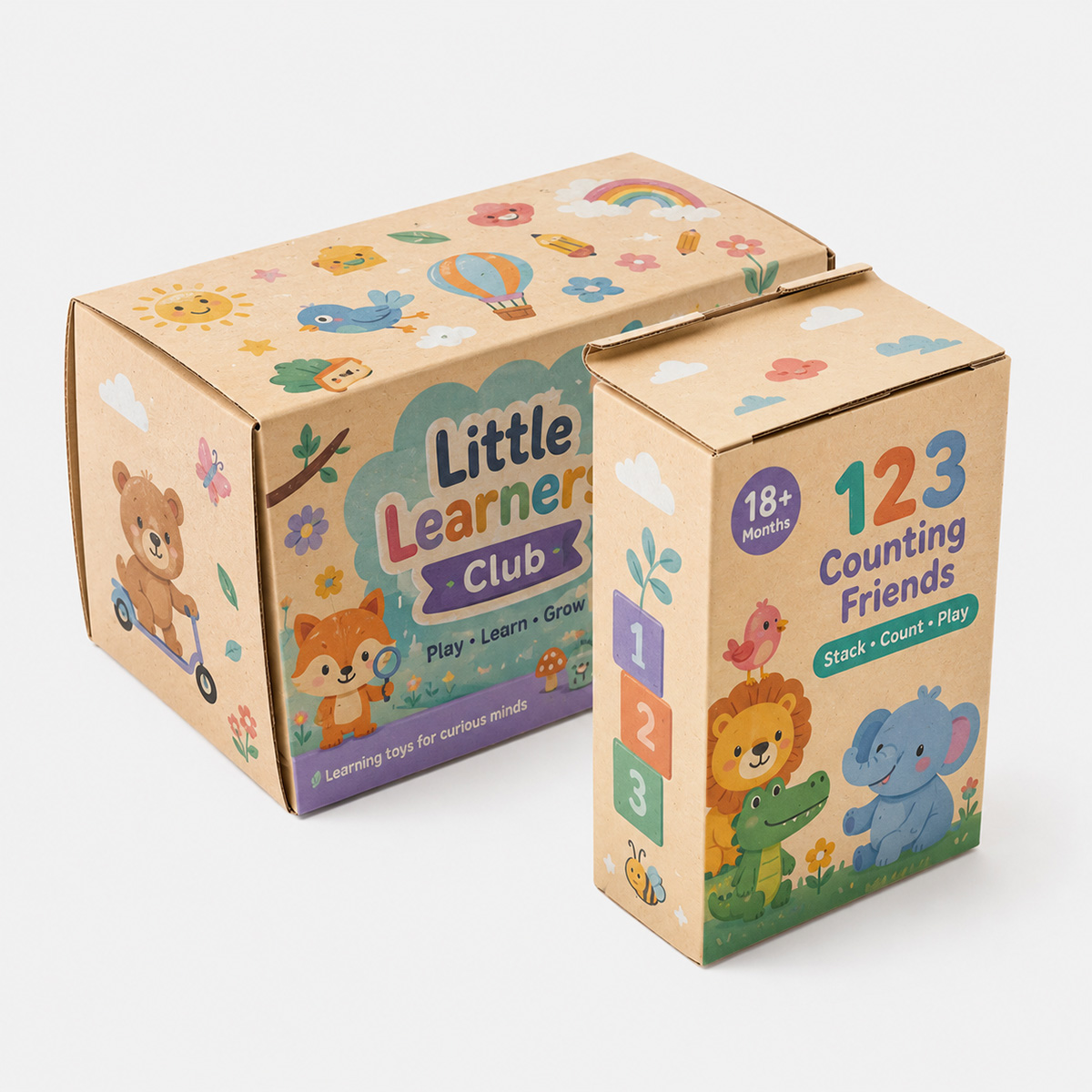
A format for developmental toys, learning games, STEM products, and skill-building toys. Educational toy packaging has a parent-forward communication brief – the primary audience is the adult purchasing the toy for its educational value, not the child who will play with it. The developmental benefits, age appropriateness, and learning outcomes need to be communicated clearly and credibly.
Available with information-rich panel designs that communicate learning benefits, developmental stage, and educational credentials. For STEM and coding toys in particular, communicating the educational methodology and real-world application of the skills developed is a primary packaging brief.
Outdoor and Active Toy Boxes
A format for outdoor play products, sports toys, and active play equipment. Outdoor toy packaging needs to communicate the energy and physical activity of the play experience – children running, jumping, throwing, catching – in a way that creates immediate appeal for active play. The packaging also needs to communicate durability and weather resistance for products used outdoors.
Available in robust formats suited to products that may be handled extensively in retail, and in configurations that can accommodate the range of shapes and sizes typical of outdoor play equipment.
Infant and Toddler Toy Boxes
A format for toys designed for the youngest children – rattles, teethers, stacking toys, soft development toys, and sensory products. Infant toy packaging has a completely different brief to older children’s toy packaging – the audience is entirely the parent or gift-giver, not the child. Safety is the primary communication requirement, and the developmental benefit needs to be communicated in a way that builds parental confidence.
The visual language is softer and calmer than older children’s toy packaging – gentle colours, rounded typography, and imagery that communicates safety and nurturing rather than energy and excitement. The age range and developmental stage labelling must be particularly clear for infant products, where the consequences of age-inappropriate use are more significant.
Choosing the Right Toy Box Configuration
Window vs illustrated front panel is the central configuration decision for most toy categories. A window that shows the actual toy communicates directly – the consumer sees what they’re getting before purchase. An illustrated front panel shows the toy in an idealised or action context that communicates the play experience. For toys where the toy’s appearance is the primary selling point – a plush character, an action figure, a premium doll – a window is usually more effective. For toys where the play experience is the primary selling point – a building set, an outdoor game, a construction vehicle – an illustrated scene may communicate better than the product alone.
Hook display requires specific structural specification. Many toy products are sold hanging from hooks in retail fixture systems. A product that’s too heavy for the hook, whose eurohole tears under the weight, or whose packaging rotates on the hook presenting the back panel to the consumer is a retail display failure. The eurohole reinforcement, the hanging point position, and the balance of the packaged product on the hook all need to be specified for the actual weight of the product and the hook depth of the specific retail fixtures where the product will be sold.
Irregular toy shapes require custom box dimensions. Most toys are not rectangular. An action figure with extended limbs, a vehicle with protruding elements, and a plush toy with an irregular soft body all require packaging dimensions and interior configurations that accommodate the actual three-dimensional shape of the specific toy. A generic rectangular box that doesn’t fit the toy produces wasted space, a poor presentation, and potentially a product that shifts and is damaged during transport. Custom dimensions are the standard for toy packaging rather than an exception.
Age range communication needs to be clear and prominent. Australian toy safety standards require age range labelling, and parents rely on it for purchase decisions. The age range should appear on the front panel in a size and position that’s visible at retail display distance. For toys at the boundaries of safety-relevant age ranges – products with small parts that are appropriate for children over three but not under three – the age labelling is a safety-critical communication requirement.
Toy Box-Specific Considerations
The toy aisle is one of the most visually competitive retail environments in any category. A child walking through the toy section of a supermarket or toy store is exposed to hundreds of competing products. Every product is designed to attract attention. The packaging that gets noticed is the packaging that has genuine visual impact – a design that has enough energy, distinctiveness, or character to stand out against the surrounding visual noise. For new toy brands entering retail, the packaging is the primary mechanism for achieving shelf presence, and it needs to do that job very effectively.
ACCC toy safety requirements are mandatory and affect the packaging design. The Australian Competition and Consumer Commission sets mandatory safety standards for toys sold in Australia, including requirements for age labelling, small parts warnings, and specific safety warnings for toys with particular hazard profiles. The warning text must appear in specified terms – it cannot be paraphrased – and at minimum specified sizes. For any toy brand entering the Australian market, the packaging labelling should be reviewed against current ACCC requirements before production. Non-compliant labelling is a product liability issue as well as a commercial one.
Collector toys have different packaging requirements to play toys. The collector toy market – limited edition figures, premium character collectibles, artist toys – has completely different packaging requirements to the mass-market play toy category. Collector toys are purchased by adults who want to see and evaluate the product closely before buying, who may display the toy in its packaging, and who evaluate the packaging quality as part of the product’s collectible value. Window packaging that shows the toy fully, rigid construction that can serve as a display case, and premium finishing that reflects the collectible nature of the product are all appropriate for collector toy packaging.
Educational toy packaging communicates primarily to parents, not children. A parent choosing a STEM toy, a developmental toy, or an educational game is making a considered purchase based on the toy’s educational merit, not its play appeal. The packaging needs to communicate the specific learning outcomes, the educational methodology, and the developmental stage clearly and credibly. Partnerships with educational organisations, curriculum alignment claims, and specific skill development outcomes are all relevant packaging content for the educational toy market.
Gift toy packaging has a distinct brief from retail toy packaging. A toy purchased as a birthday or Christmas gift is bought with different motivations than a toy purchased for everyday play. Gift purchase decisions are influenced by the packaging quality as much as the toy quality – a toy that looks like a good gift, that presents well when given, and that communicates the giver’s thoughtfulness is worth more in a gifting context than the same toy in generic packaging. For toy brands with a strong gifting component to their sales, having a packaging format that works as a gift presentation is worth considering.
Print & Finishing for Toy Boxes
Toy packaging spans from the bold, character-driven energy of mass-market children’s toys to the refined, collector-grade presentation of premium and limited edition products.
Mass-market children’s toy packaging uses maximum visual energy – saturated colour, dynamic character poses, action-oriented background scenes, and bold typography that communicates excitement and fun. Full colour printing on a gloss laminate is the standard approach – gloss gives colours maximum saturation and communicates the vibrancy of the play experience. The design should be genuinely energetic, not just colourful – a flat, static design with bright colours doesn’t have the same visual impact as a dynamic composition with genuine movement and character.
Educational toy packaging uses a different visual register – cleaner design, illustrated learning scenarios rather than action scenes, and a colour palette that reads as developmental and nurturing rather than exciting. The parent needs to read and evaluate the packaging, so information clarity and legibility are design priorities alongside visual appeal.
Collector toy packaging uses the most restrained approach of any toy format – clean design, high-quality product photography, and a finish that communicates premium quality. Matte laminate, foil detail on the brand or edition mark, and rigid construction that functions as a display case communicate collectible value. The packaging should feel as premium as the figure or product inside it.
Infant toy packaging uses soft colours, rounded design elements, and imagery that communicates safety and nurturing. The design should feel gentle and reassuring to the parent – the visual language references the developmental stage of the child and the care that went into the toy’s design.
All boxes are printed using full colour printing in CMYK. Files should be supplied as Adobe Illustrator (.ai) or high-resolution print-ready PDF, with fonts outlined and graphics embedded. Free design support is included – we’ll produce a free 3D mockup for your approval before production begins, and handle minor artwork adjustments at no extra charge. Free dieline templates are available if you’re building your artwork from scratch.
Materials & Specifications
We manufacture toy boxes in a full range of cardboard and paperboard materials to suit different toy formats and retail environments. Eco friendly and recyclable options are available across the range. All materials meet relevant Australian safety standards for toy product packaging applications.
- Single copper paper
- White kraft
- Brown kraft
- Black kraft
- Gold foil paper
- Silver foil paper
- Corrugated board
Minimum order quantity is 1,000 units. Air freight runs approximately 3 – 4 weeks from production sign-off; sea freight is approximately 8 weeks. We supply toy businesses across Australia including Sydney, Melbourne, and Brisbane. For more detail on the full order process, artwork requirements, and lead times, get in touch and we’ll walk you through it.
Join our newsletter for 10% off your first order
Get our emails for info on new items, sales and much more.

Vivo Packaging Pty Ltd
Aussie Warehouse:
4 Tasman Ct, Keysborough VIC 3173, Australia
Monday – Friday: 9.30am – 5.30pm
Visitors By Appointment Only

Need Help?
Copyright 2026 © VIVO CUSTOM BOXES. ALL RIGHTS RESERVED.