
Custom Granola & Cereal Boxes
Granola and cereal packaging occupies an interesting position in the food packaging category. The products are light but bulky – a 500-gram box of granola takes up considerably more shelf space than a 500-gram box of nuts – which means the packaging has a large exterior surface relative to the weight of the product. That surface area is one of the biggest branding opportunities in food retail: a well-designed cereal or granola box has more printable real estate than almost any other food format, and in a category where the packaging is often displayed face-forward on a shelf or pantry at home, that print surface does a lot of work.
The product itself has specific sensitivities. Granola clusters, cereal flakes, and toasted oat products are brittle and absorb moisture – humidity is the primary quality risk, and a granola that’s been exposed to moisture loses the crunch that defines it. The packaging needs to work with the inner bag to keep the product dry and intact from production through to the last bowl.
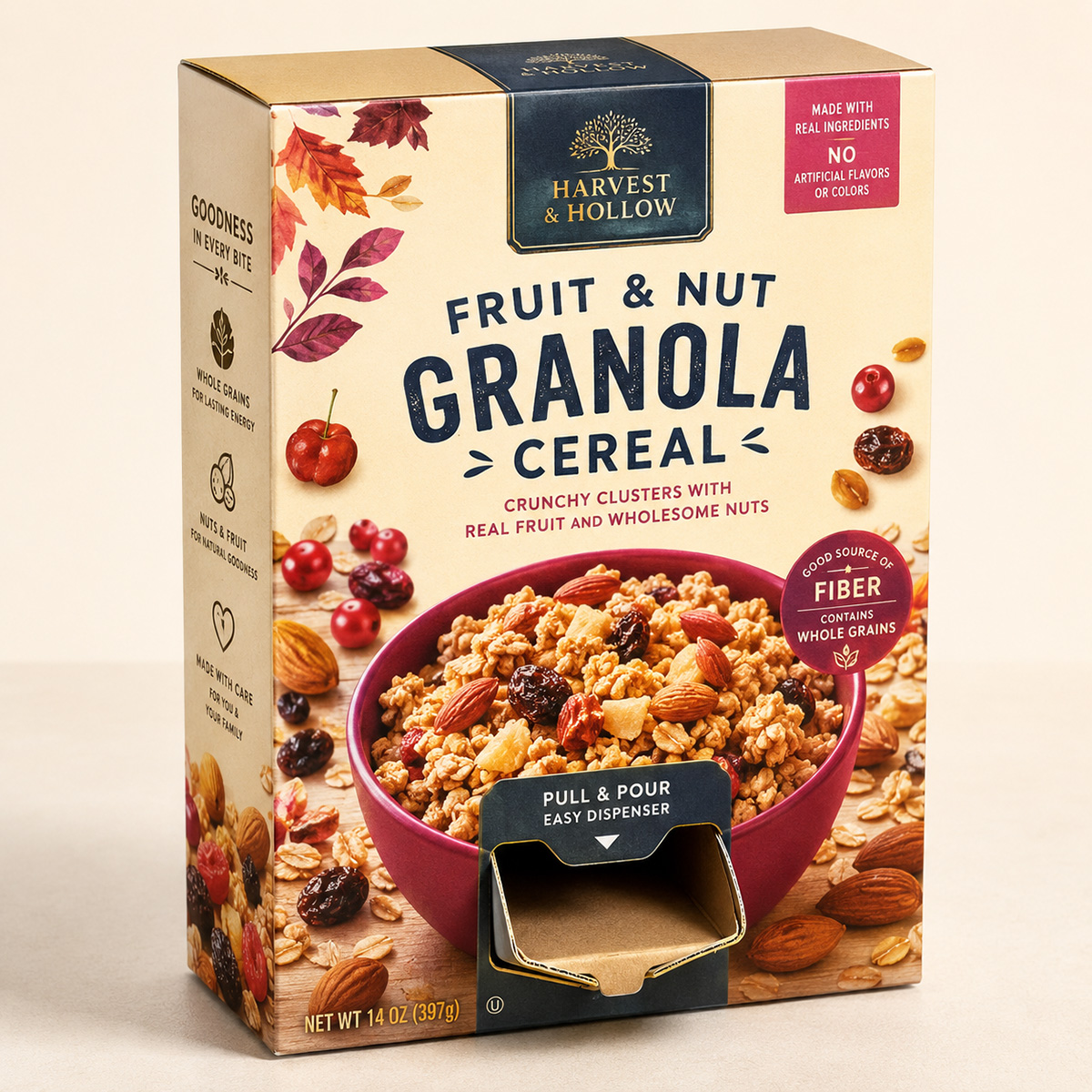
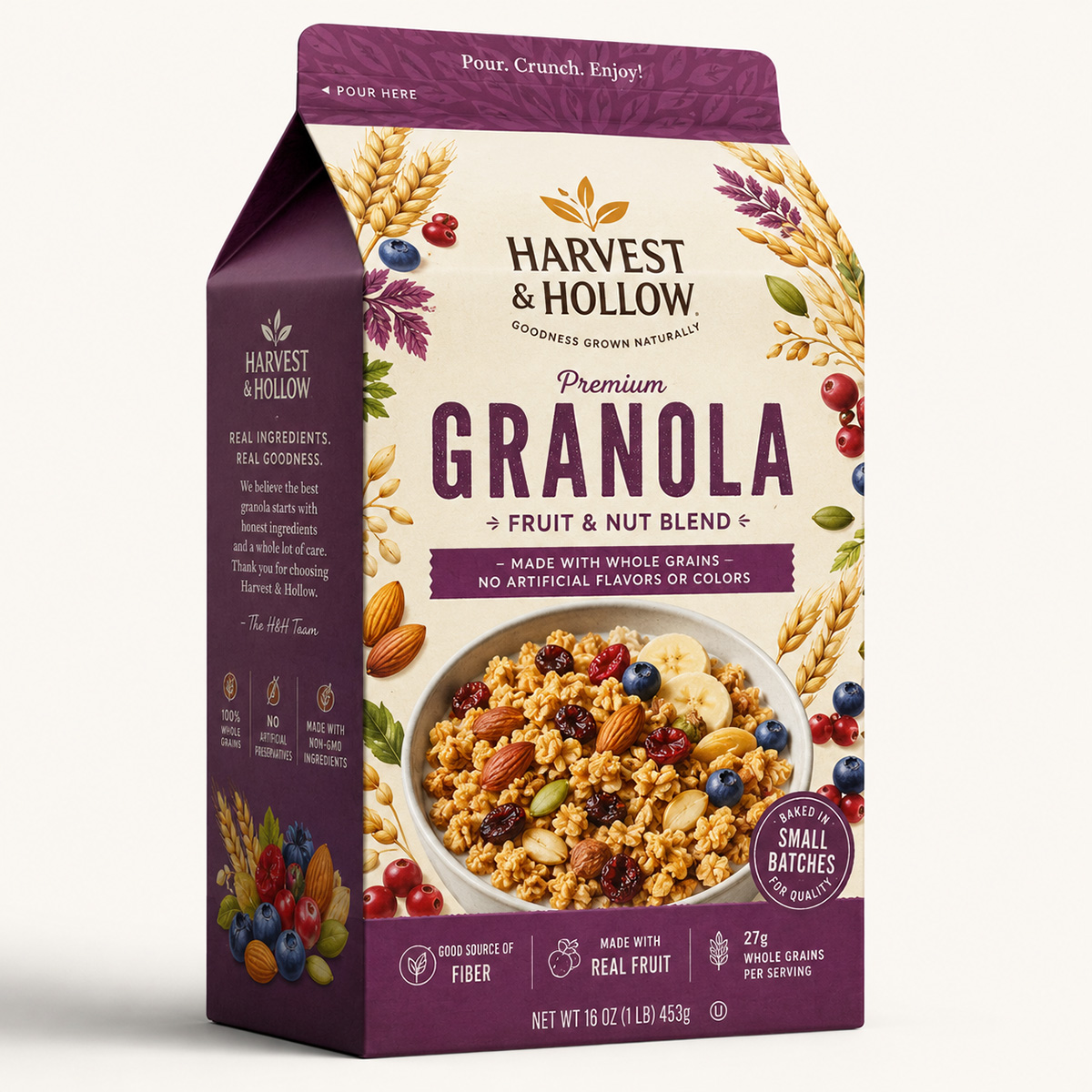
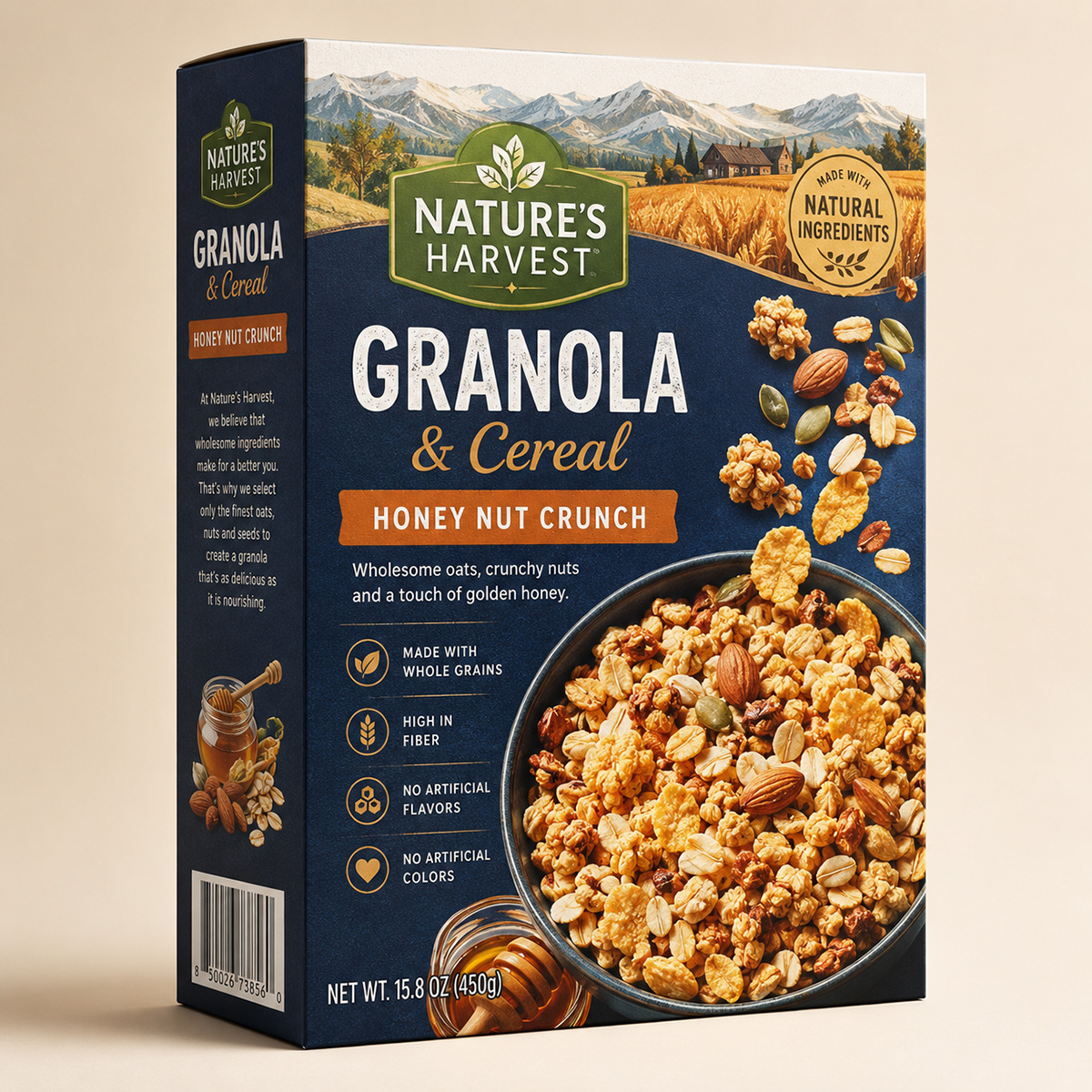
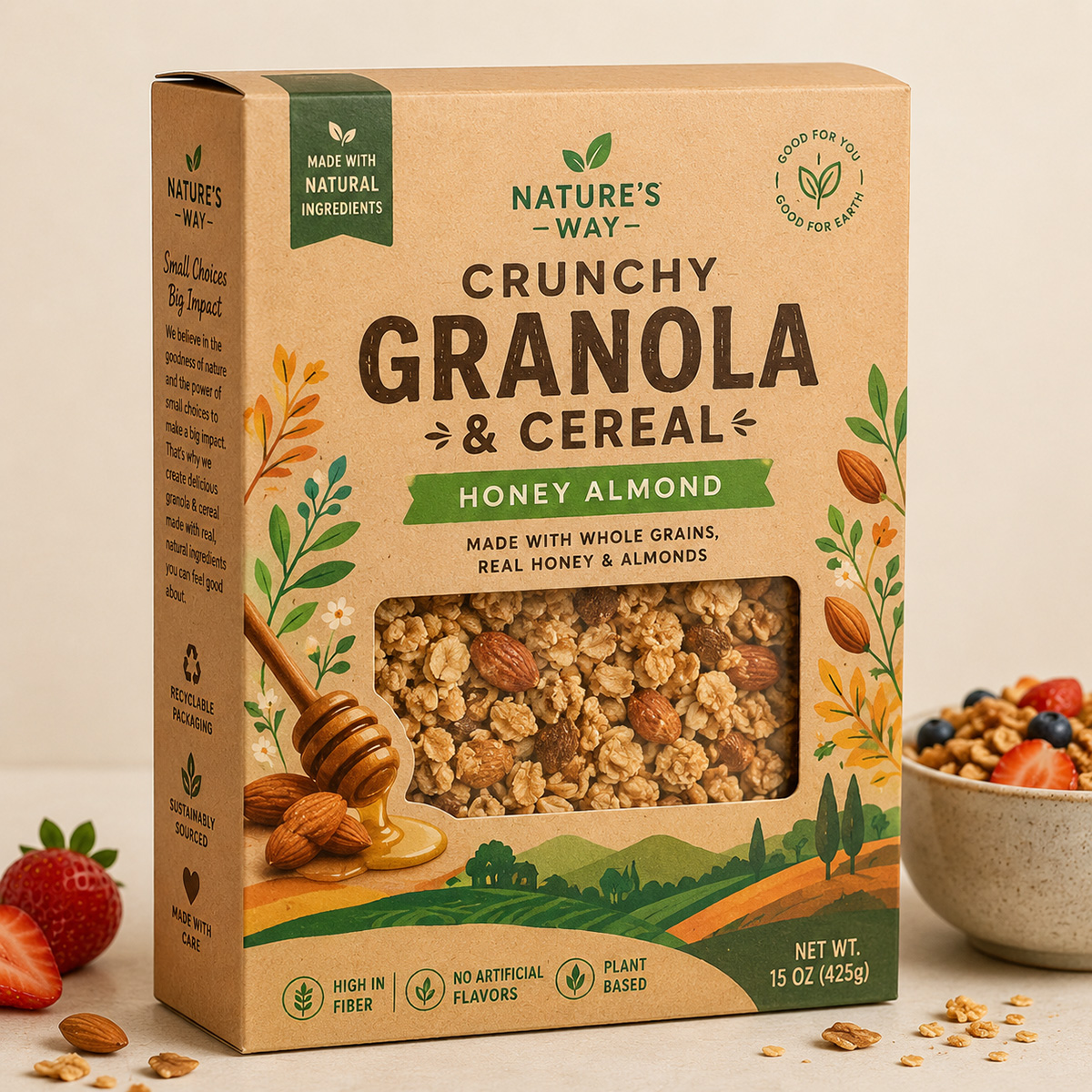
Our custom cereal boxes and cardboard cereal boxes are manufactured to suit the specific product format, retail context, and brand positioning of your cereal brand or granola range. We’ve been supplying cereal box packaging and granola packaging options to Australian food businesses since 2017, with both offset printing for large runs and digital printing for short runs and seasonal releases.
Get in touch today to discuss your requirements or request a quote.
Order Process
We quote on the box style of your choice
We receive your final design on a die line template
We send you an invoice to pay
We send you 3D mockups to confirm and start production
We ship the order to you by air or by sea
Request a Quote
To request an accurate quote from us, please fill out the form below. If you have any questions about using this form, please send an email to [email protected]
Granola & Cereal Box Styles We Offer
We manufacture custom granola and cereal boxes across a range of styles to suit different products and markets. All styles are available in custom sizes, materials, and finishes.
Retail Cereal Boxes
The standard format for cereal and granola sold through supermarkets and grocery retail. A retail cereal box is one of the most recognisable packaging formats in food retail – the tall, rectangular carton with a full-face front panel, a tuck-top closure, and an inner bag that holds the product. Custom printed cereal boxes need to meet retail shelf display requirements, accommodate the mandatory nutritional information panel and ingredient declaration, and communicate the brand clearly at eye level on a supermarket shelf. Customization options span size, print, and finish to suit your specific product and retail environment.
Available in standard retail dimensions that suit shelf planogram requirements, with custom sizing available for products that don’t fit standard formats. The front panel of a retail cereal box is one of the most valuable brand real estate pieces in food packaging – it’s viewed at close range, repeatedly, by consumers who spend time comparing options on a shelf.
Artisan Granola Boxes
A premium format for specialty and artisan granola – products made in small batches, with premium ingredients, for health food stores, specialty grocers, and direct-to-consumer channels. Artisan granola commands a higher price point than mass-market cereal, and the packaging needs to communicate that positioning clearly.
Artisan granola boxes typically use a shorter, wider format than standard retail cereal boxes – a format that suits display on a health food store shelf or counter rather than a supermarket planogram. The print treatment is more considered and less information-dense than mass retail packaging – the emphasis is on ingredients, provenance, and brand story rather than nutritional comparison claims.
Granola Gift Boxes
A format for gifting – a premium granola in a gift-worthy presentation, a curated selection of varieties, or a breakfast gift set pairing granola with honey, dried fruit, or other accompaniments. Granola gift boxes are a growing format in the Australian health food gifting market, particularly for Mother’s Day, Christmas, and corporate wellness gifting.
The interior configuration needs to hold the product or inner pouches in a presentable arrangement, and the exterior finish needs to match the gifting context. A granola gift box is a different product to a retail granola box, and the packaging brief should treat it that way.
Granola Pouch Boxes
A secondary box format for granola sold in an inner resealable or sealed pouch. The pouch handles the primary food safety and freshness function; the outer box provides retail shelf structure, a larger print surface, and brand presence that a flexible pouch alone doesn’t achieve in a retail display environment.
The box dimensions need to accommodate the filled pouch precisely – a box that’s too large looks empty or allows the pouch to collapse inside; a box that’s too small can’t close without compressing the pouch in a way that damages the product inside. The pouch dimensions at full fill, not empty, should be the basis for the box specification.
Bulk and Wholesale Boxes
A high-volume format for wholesale supply and food service. Structural robustness and efficient volume are the primary requirements. Bulk granola and cereal boxes need to hold the product without crushing during transit, stack safely in a warehouse, and be clearly identified with product name, weight, allergen information, and storage instructions.
Choosing the Right Configuration
The configuration decisions for granola and cereal packaging depend on the product format, the retail environment, and the relationship between the outer box and the inner packaging.
Volume-to-weight ratio affects the structural specification differently to most food products. Granola and cereal are among the lightest food products per unit volume – a large cereal box may weigh only 400 to 500 grams when full. This means the base construction doesn’t need to be specified for high load-bearing in the way that nut or wine packaging does, but the walls and top need to resist compression during stacking – a full pallet of cereal boxes places significant downward pressure on the boxes below, and a box that compresses under stacking loads will be misshapen by the time it reaches the shelf.
Inner bag compatibility is the primary food safety consideration. Almost all granola and cereal is sold with an inner wax or plastic bag that handles the moisture barrier and direct food contact functions. The outer box sits around that inner bag. The box dimensions need to be specified for the inner bag at its filled dimensions – not the empty bag, and not an approximate estimate of the filled volume. A bag that’s too large for the box will crumple and look poorly presented when the top is opened; a bag that’s too small for the box leaves visible excess space that communicates poor quality.
Tuck-top closure mechanics. The standard cereal box closure – a tuck-top with glued or interlocking tuck flaps – is a simple, functional mechanism that consumers use repeatedly over the life of the product. The closure needs to open cleanly on the first use and re-close securely for subsequent uses. A closure that tears on opening or doesn’t re-close properly is a product quality issue that affects repeat purchase behaviour. The board weight and the die-cut geometry of the tuck closure are specification details that affect the functional performance of the box in daily use.
Supermarket shelf planogram requirements. Cereal and granola products sold through major supermarkets typically need to conform to shelf planogram specifications – standard heights, widths, and depths that allow the product to fit the allocated shelf space. For businesses entering supermarket distribution for the first time, understanding the planogram requirements of the relevant retailer before finalising the box dimensions can prevent a costly redesign after the packaging is produced.
Granola & Cereal-Specific Considerations
A few properties of granola and cereal as products that create packaging requirements specific to this category.
Moisture is the primary and most damaging quality risk. A granola that has absorbed moisture from its environment loses its defining quality – the crunch. Keeping granola and cereal fresh requires packaging that maintains an effective moisture barrier throughout the product’s shelf life. Eco friendly materials with moisture resistant properties are available across our range, allowing brands with sustainability commitments to protect the product without compromising on environmental values. The inner bag is the primary defence, but the outer box should not contribute to the moisture problem – a box material that is itself hygroscopic, or that allows moisture ingress through poor sealing, can compromise the inner bag’s ability to protect the product over the shelf life period.
Granola clusters and cereal flakes are brittle and crush easily. Unlike nuts or dried fruit, which can withstand moderate compression without visible damage, granola clusters break under pressure and cereal flakes crush to dust. Packaging that allows the product to be compressed – by an overly tight box, by stacking loads that transfer through to the product, or by a box that collapses during transport – will result in a product that’s broken and dusty by the time it reaches the consumer. The inner bag needs adequate space to hold the product without compression, and the outer box needs stacking strength sufficient to resist the loads it will experience in a warehouse and distribution environment.
Nutritional labelling for cereal is among the most complex in food retail. Australian Food Standards require a nutritional information panel for cereal products, and the cereal category has additional conventions – per serve and per 100g comparisons, serving size definitions, and in some cases health star ratings. For cereals with added vitamins or making specific health claims, additional labelling requirements apply. The front-of-pack and back-of-pack design needs to accommodate all mandatory information within the available panel area, which requires careful layout planning before the artwork is finalised.
The artisan granola market has strong ingredient and provenance storytelling expectations. Premium granola consumers are highly engaged with ingredients – they look for specific oat varieties, honey sources, nut origins, and minimal additive lists. The packaging for an artisan granola product needs to communicate this story clearly and credibly. The back panel of an artisan granola box is often as important as the front panel – it’s where the ingredient story, the production philosophy, and the brand values are communicated to a consumer who has already picked the box up and is deciding whether to buy.
DTC granola subscription is a fast-growing format. Granola subscription services – a regular delivery of freshly made granola, often with rotating flavours – are one of the fastest-growing direct-to-consumer food formats in Australia. The packaging for a DTC granola subscription needs to protect the product through courier delivery – which is more demanding than retail distribution – and create a positive unboxing experience that subscribers look forward to. Consistent print quality and construction across multiple deliveries builds brand equity with the subscriber over time.
Supermarket ranging and facing requirements. For granola and cereal sold through major supermarket chains, the packaging format may need to meet specific facing requirements – the width of the front panel relative to the shelf allocation, the number of facings per SKU, and the overall shelf impact when multiple units of the same product are displayed side by side. These requirements are typically communicated by the retailer’s ranging team and should be factored into the packaging specification before production.
Print & Finishing for Granola & Cereal Boxes
Granola and cereal packaging has one of the largest print surfaces relative to product weight of any food category – and in a retail environment where the packaging is displayed at eye level and inspected closely, that surface needs to work hard.
Mass retail cereal packaging is designed for shelf impact and category legibility. Bold colours, large typography, prominent health and nutrition claims, and a design that reads as part of the brand family across multiple SKUs are all important. Offset printing on a gloss or matte laminate is the standard approach for large retail runs, delivering consistent colour across high volumes. For short runs – seasonal releases, limited edition flavours, or test market quantities – digital printing provides the flexibility to produce smaller quantities without the plate costs of offset.
Artisan granola packaging has a distinct and increasingly well-established aesthetic – natural materials, ingredient-forward design, considered typography, and a visual language that communicates craft and quality. Kraft paper stock, matte or uncoated finishes, and a restrained colour palette that references natural ingredients are common in this segment. The design should communicate that the product is made with care and real ingredients, which means the packaging itself should feel considered and honest.
Gift set and premium presentation packaging warrants a step up in finish – matte laminate with foil stamp or emboss detail on the brand mark, a considered colour palette, and an interior that presents the product attractively when the box is opened. A granola gift box needs to read as a premium food gift, not a retail product in a nicer box.
The back panel is a storytelling opportunity that many brands underuse. In the cereal and granola category, consumers spend significant time reading the back of the box – whether at the breakfast table, in the supermarket aisle, or when deciding whether to subscribe. The back panel is where the ingredient story, the production philosophy, the sustainability credentials, and the brand values all have space to be communicated properly. For artisan and premium brands in particular, the back panel is as important a design brief as the front.
All boxes are printed using full colour printing in CMYK. Files should be supplied as Adobe Illustrator (.ai) or high-resolution print-ready PDF, with fonts outlined and graphics embedded. Free design support is included – we’ll produce a free 3D mockup for your approval before production begins, and handle minor artwork adjustments at no extra charge. Free dieline templates are available if you’re building your artwork from scratch.
Materials & Specifications
We manufacture granola and cereal boxes in a full range of cardboard and paperboard materials to suit different products and market positions. Eco friendly and recyclable options are available across the range. All materials are food grade and food safe.
- Single copper paper
- White kraft
- Brown kraft
- Black kraft
- Gold foil paper
- Silver foil paper
- Corrugated board
Minimum order quantity is 1,000 units. Air freight runs approximately 3 – 4 weeks from production sign-off; sea freight is approximately 8 weeks. We supply granola and cereal businesses across Australia including Sydney, Melbourne, and Brisbane. For more detail on the full order process, artwork requirements, and lead times, get in touch and we’ll walk you through it.
Join our newsletter for 10% off your first order
Get our emails for info on new items, sales and much more.

Vivo Packaging Pty Ltd
Aussie Warehouse:
4 Tasman Ct, Keysborough VIC 3173, Australia
Monday – Friday: 9.30am – 5.30pm
Visitors By Appointment Only

Need Help?
Copyright 2026 © VIVO CUSTOM BOXES. ALL RIGHTS RESERVED.