
Custom Pizza Boxes
The pizza box is one of the most recognisable packaging formats in the world, and for good reason. It’s an elegant solution to a genuinely difficult packaging problem: a large, flat, hot, steam-producing food product that needs to travel reliably, arrive hot, and ideally arrive with a crispy base intact. The corrugated cardboard square box with perforated ventilation holes has been the industry standard for decades because it works – structurally robust, adequately insulating, and ventilated well enough to manage the steam that would otherwise make the base soggy.
In the Australian market, pizza is one of the highest-volume takeaway categories, and it’s also one of the most competitive. The pizza box is the most significant brand touchpoint in the entire transaction – it’s large, it sits on the table throughout the meal, and it’s often photographed and shared. For independent pizza restaurants and artisan pizza makers competing against established chains, the packaging design is a meaningful differentiator.
Our custom pizza boxes are manufactured to suit the specific pizza size, service context, and brand positioning of your pizza business. We’ve been supplying pizza packaging to Australian pizzerias and food businesses since 2017.
Get in touch today to discuss your requirements or request a quote.

Order Process
We quote on the box style of your choice
We receive your final design on a die line template
We send you an invoice to pay
We send you 3D mockups to confirm and start production
We ship the order to you by air or by sea
Request a Quote
To request an accurate quote from us, please fill out the form below. If you have any questions about using this form, please send an email to [email protected]
Pizza Box Styles We Offer
We manufacture custom pizza boxes across a range of sizes and styles to suit different pizza formats and service contexts. All styles are available with custom print and finish options.
Standard Pizza Boxes
The industry-standard format for round pizzas – a corrugated cardboard square box with a fold-over lid, ventilation holes in the sides or lid, and a food-safe base. Available in the full range of standard pizza sizes: 7 inch, 9 inch, 10 inch, 12 inch, 14 inch, and 16 inch, with custom sizes available for non-standard products.
The base construction needs to support the full weight of a loaded pizza without flexing – a base that bends under the weight of a deep-pan pizza or a heavily topped pizza allows the pizza to slide within the box and arrive in a dishevelled state. The corrugated construction provides both structural support and some insulation value that helps maintain the pizza’s temperature during delivery.
Rectangular Pizza Boxes
A format for rectangular or square pizzas – roman-style pizza, Detroit-style, and other non-round formats that don’t suit a standard square box. Rectangular pizza boxes are configured to the specific dimensions of the pizza rather than to a standard size, with the same structural requirements as round pizza boxes but a different aspect ratio.
Available in a range of sizes to suit different rectangular pizza formats. For pizzerias that specialise in non-round pizza styles, having a box specifically configured to the product’s dimensions presents the pizza more effectively than trying to use an oversized standard square box.
Half Pizza and Pizza Slice Boxes
A format for half pizzas and individual slices – the primary format for pizza sold by the slice in cafes, bakeries, and convenience retail. Pizza by the slice is typically a cold or reheated product, rather than a freshly made delivery pizza, and the packaging requirements are different – less emphasis on steam management and heat retention, more emphasis on a compact, easy-to-carry format.
Available in triangular formats for standard pizza slice portions, and in half-circle or rectangular formats for half pizzas. For cafe and retail operators selling pizza by the slice, a well-designed slice box is a significant brand touchpoint at the counter.
Mini Pizza Boxes
A format for personal-size pizzas – typically 6 to 8 inch formats for individual consumption. Mini pizza boxes are used by restaurants offering personal pizza options, by school canteens, and by catering operations serving individual portions at events. The box dimensions are proportionally similar to standard pizza boxes but smaller, with the same structural and ventilation requirements scaled to the product size.
Premium and Gourmet Pizza Boxes
A format for artisan and gourmet pizza at the premium end of the market – Neapolitan-style pizzas from wood-fired ovens, specialty ingredient pizzas, and high-end pizzeria products that are positioned significantly above the standard delivery pizza market. Premium pizza boxes warrant a step up in construction quality, print treatment, and overall presentation to match the positioning of the product.
Available with heavier board weight, more refined print and finish treatments, and design options that communicate the premium nature of the pizza inside. For artisan pizzerias competing on quality and authenticity, the box is part of the product story.
Choosing the Right Pizza Box Configuration
The configuration decisions for pizza boxes depend on the pizza size, the pizza style, and the service context.
Standard size adherence simplifies the specification for most pizzerias. The pizza industry has largely standardised around a set of common sizes – 9, 10, 12, 14, and 16 inch are the most common Australian formats – and boxes in these sizes are available with predictable fit. The box should fit the pizza closely – a pizza that slides around inside a box that’s too large will arrive with disturbed toppings; a pizza in a box that’s too small will have its toppings compressed by the lid. Custom sizes are available for pizzas that don’t fit standard dimensions.
Corrugated vs solid board construction. Corrugated cardboard is the industry standard for pizza boxes because it provides the combination of structural strength, base rigidity, and insulation value that pizza requires. Solid paperboard is lighter and less expensive, but it provides less structural support and less insulation. For delivery pizza, corrugated construction is the practical standard. For counter-sale slice boxes and catering formats where insulation and structural requirements are less demanding, solid paperboard may be adequate.
Ventilation hole placement affects steam management. The ventilation holes in a pizza box – typically in the lid, the sides, or both – allow steam produced by the hot pizza to escape, reducing the humidity inside the box and slowing the softening of the base. The placement and quantity of ventilation holes affects the balance between steam release and heat retention. More ventilation releases steam more effectively but cools the pizza faster. The industry-standard perforated hole configuration is well-tested, but for pizzerias with specific delivery time ranges, the ventilation specification can be adjusted.
Stacking for multi-pizza delivery. When multiple pizzas are delivered together, the boxes are stacked – and the weight of the upper boxes rests on the lower boxes. For a standard delivery of three or four pizzas, the weight on the bottom box is manageable with adequate base construction. For catering or event delivery of ten or more boxes, the stacking weight is significant. The base construction and the stacking strength of the box need to be considered for the maximum expected stack height of the delivery configuration.
Pizza Box-Specific Considerations
A few properties of pizza that create specific packaging requirements.
The base of the pizza is the most vulnerable component. The crispy base of a well-made pizza is the first thing to suffer if the packaging isn’t managing steam effectively. Steam produced by the hot toppings and cheese condenses on the cooler surface of the base, rehydrating the crust from below. This process is inevitable to some degree, but it’s slowed significantly by ventilation that allows the steam to escape rather than condensing inside the box. The ventilation design of a pizza box is not decorative – it’s a functional element that directly affects the quality of the pizza on arrival.
Cheese and toppings can stick to the lid. If the pizza is too close to the lid – because the box is too shallow for the depth of the toppings, or because the box has been compressed – the cheese and toppings will adhere to the interior of the lid when the pizza cools slightly. Opening the box tears the cheese off the pizza and produces an immediately poor first impression. The interior lid height needs to clear the highest point of the toppings – which for a deeply loaded pizza can be several centimetres above the base. The standard approach in the industry – a small plastic or cardboard tripod in the centre of the pizza – prevents the lid from touching the toppings, but the box dimensions should be specified to avoid contact even without the tripod.
Large pizza boxes have significant structural requirements. A fully loaded 16-inch pizza – heavy toppings, thick crust – can weigh 1.2 kilograms or more. The corrugated base of the box needs to support this weight without flexing, both when the box is carried flat and when it’s set down on a surface. A base that flexes under the weight of a heavy pizza causes the pizza to slide within the box and creates an uneven presentation. Base rigidity is a specification consideration that’s more important for large sizes than for small.
The pizza box is the largest brand surface in fast food packaging. A 14-inch pizza box has a lid surface of approximately 360 square centimetres – significantly larger than a burger box, a chip cup, or any other standard fast food packaging format. This surface is flat, visible throughout the meal, and often photographed. For pizza businesses with a strong brand identity, the investment in a well-designed, well-printed pizza box has a return that’s disproportionate to the surface area alone – the box is seen repeatedly during the meal by everyone at the table.
Independent pizzerias have a design opportunity that chains don’t. A national pizza chain has an established visual system that the packaging executes consistently. An independent pizzeria has no such constraint – the packaging design can be as specific to the character of the restaurant as the pizza itself. A Neapolitan pizza restaurant with a strong Italian heritage identity, or a contemporary artisan pizza restaurant with a distinctive visual personality, can create a pizza box that’s immediately recognisable and communicates the brand as effectively as any other marketing investment.
Print & Finishing for Pizza Boxes
Pizza boxes offer the largest and most sustained brand impression in the fast food category, and the print approach should take full advantage of this.
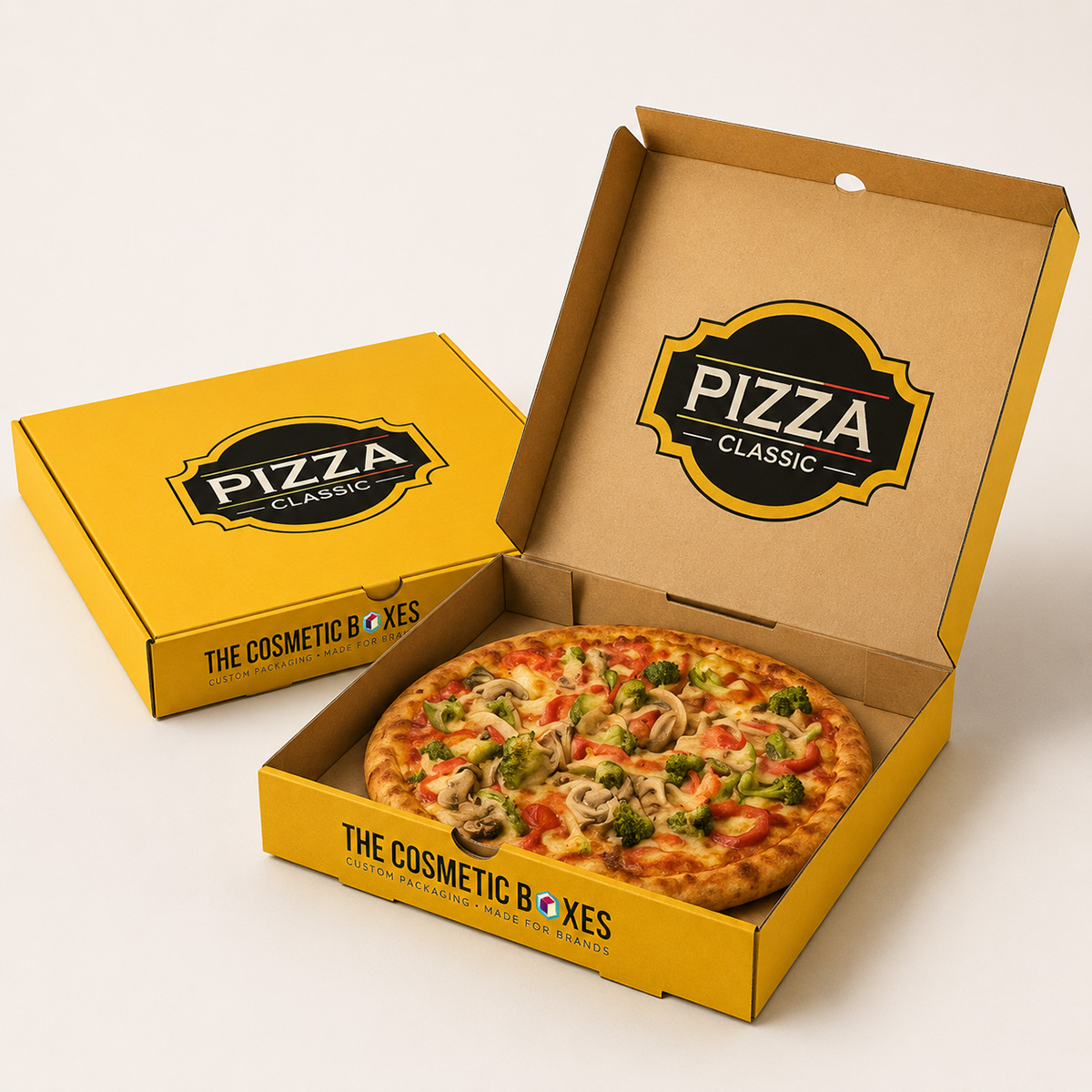
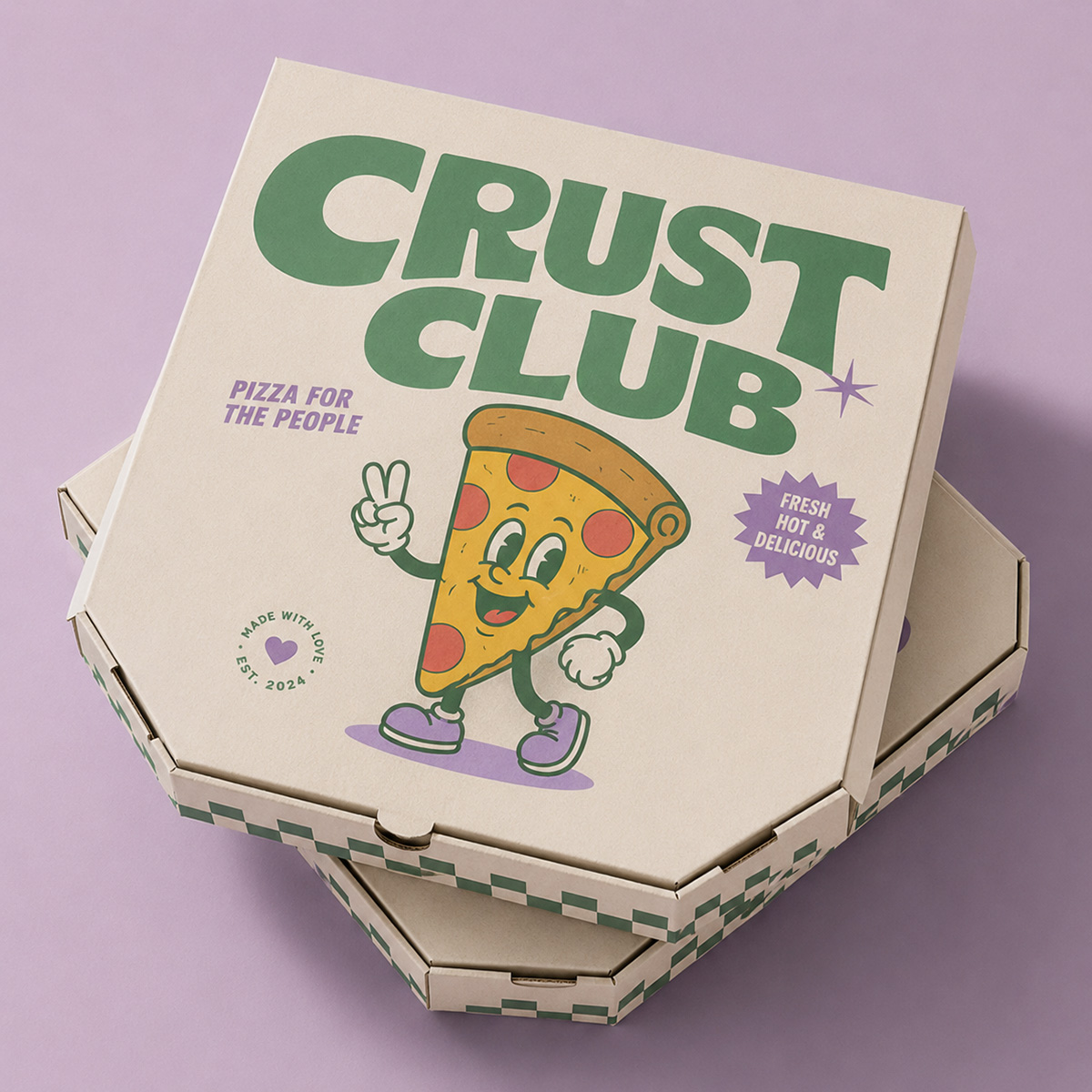
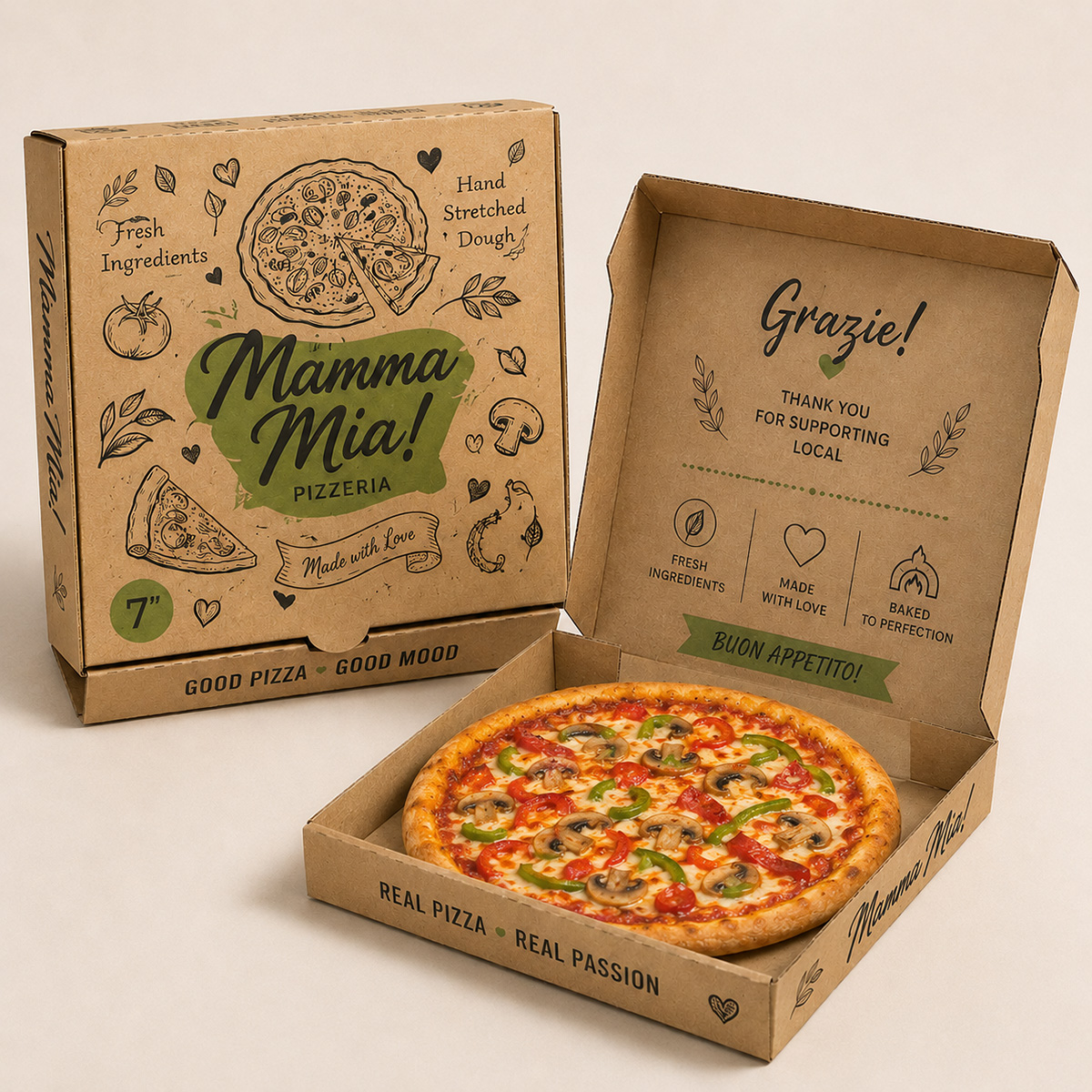
Full-coverage lid design is the most effective use of the pizza box’s brand surface. The entire lid is visible throughout the meal, and a design that uses the full surface – rather than a small logo in the centre surrounded by blank space – communicates a brand that’s invested in its identity. Bold illustration, strong colour, and design elements that tell the brand’s story are all appropriate for a full-coverage pizza box design.
The ventilation holes are a design element. The die-cut ventilation holes in a pizza box lid are a functional requirement, but they’re also a design element – they interrupt the print surface and need to be incorporated into the design rather than treated as an afterthought. Well-designed pizza boxes integrate the ventilation holes into the overall composition, using them as visual elements or placing them in positions where they don’t interrupt key brand or design elements.
Independent pizzeria design benefits from the full expression of the restaurant’s personality – whether that’s Italian heritage imagery, a bold and contemporary graphic system, a vintage poster aesthetic, or a clean and minimal design that communicates premium quality. The pizza box is a large, flat canvas that rewards creative investment. Full colour printing in CMYK on a white or kraft corrugated base is the standard approach.
Chain and franchise design needs to deliver brand consistency across multiple locations and production runs. Colour accuracy, consistent construction, and reliable supply at volume are the practical requirements alongside the visual design.
All boxes are printed using full colour printing in CMYK. Files should be supplied as Adobe Illustrator (.ai) or high-resolution print-ready PDF, with fonts outlined and graphics embedded. Free design support is included – we’ll produce a free 3D mockup for your approval before production begins, and handle minor artwork adjustments at no extra charge. Free dieline templates are available if you’re building your artwork from scratch.
Materials & Specifications
We manufacture pizza boxes in corrugated cardboard and solid paperboard, with food-safe base liners and grease-resistant coatings available. Eco friendly and recyclable options are available. All materials are food grade and food safe.
- Single copper paper
- White kraft
- Brown kraft
- Black kraft
- Gold foil paper
- Silver foil paper
- Corrugated board
Minimum order quantity is 1,000 units. Air freight runs approximately 3 – 4 weeks from production sign-off; sea freight is approximately 8 weeks. We supply pizzerias and food businesses across Australia including Sydney, Melbourne, and Brisbane. For more detail on the full order process, artwork requirements, and lead times, get in touch and we’ll walk you through it.
Join our newsletter for 10% off your first order
Get our emails for info on new items, sales and much more.

Vivo Packaging Pty Ltd
Aussie Warehouse:
4 Tasman Ct, Keysborough VIC 3173, Australia
Monday – Friday: 9.30am – 5.30pm
Visitors By Appointment Only

Need Help?
Copyright 2026 © VIVO CUSTOM BOXES. ALL RIGHTS RESERVED.