
Custom Sandwich Boxes
Sandwiches are one of the highest-volume food-to-go products in the Australian market. In the morning rush at a busy city cafe, a sandwich might be the most frequently packaged item on the menu – assembled, boxed, and handed over dozens of times an hour. In that environment, packaging that’s slow to assemble, awkward to close, or prone to failure under the weight of a well-filled sandwich is a real operational problem.
The product itself has specific packaging requirements that are easy to underestimate. Bread absorbs moisture – from the filling, from the environment, and from its own steam if it’s been toasted – and packaging that traps moisture will produce a soggy sandwich within minutes. A heavily filled sandwich is under compression pressure from its own weight, and packaging that doesn’t provide adequate structural support will allow the sandwich to be compressed out of shape during transport. And for hot sandwiches, the steam from a freshly toasted bread creates the same softening problem that waffles and other hot products face.
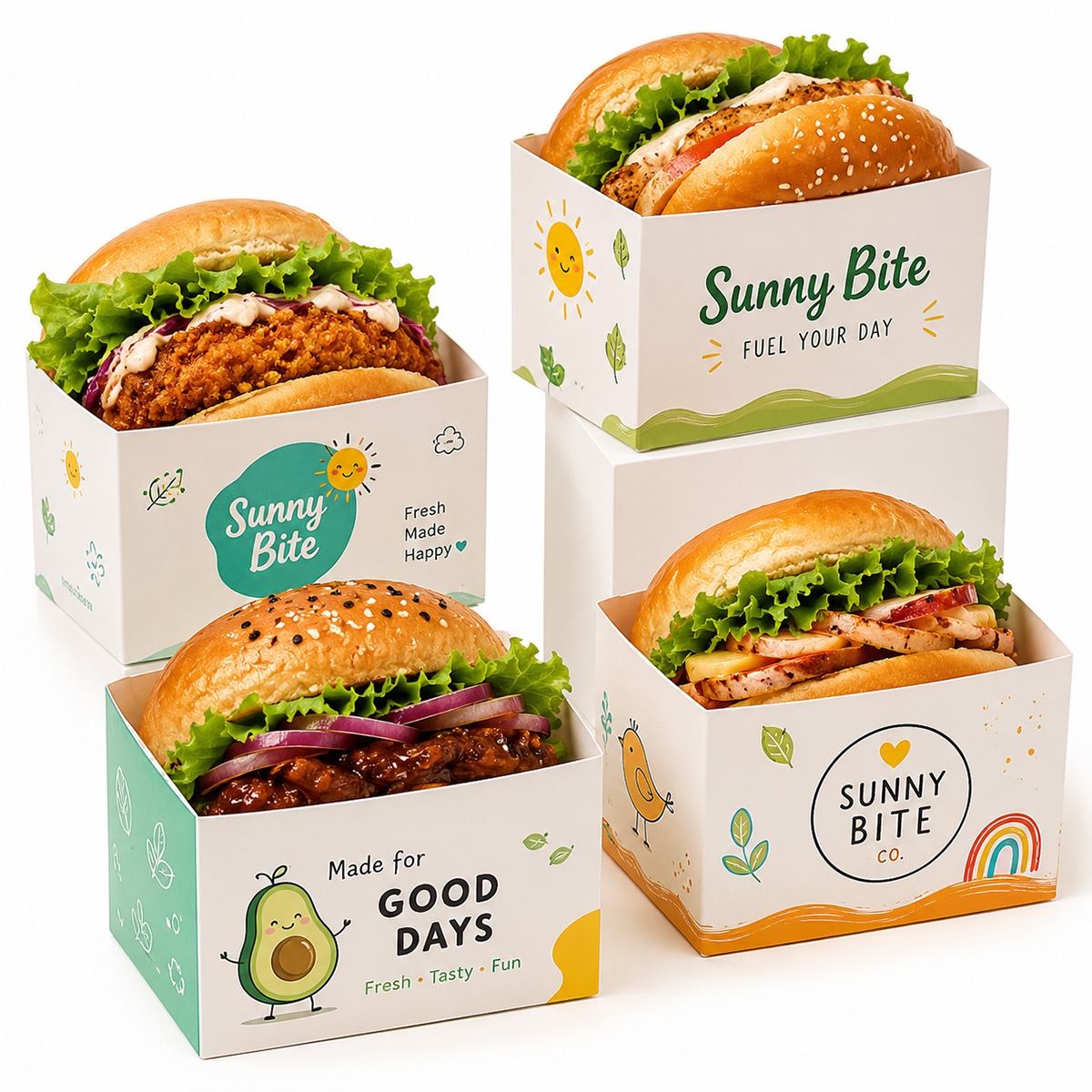
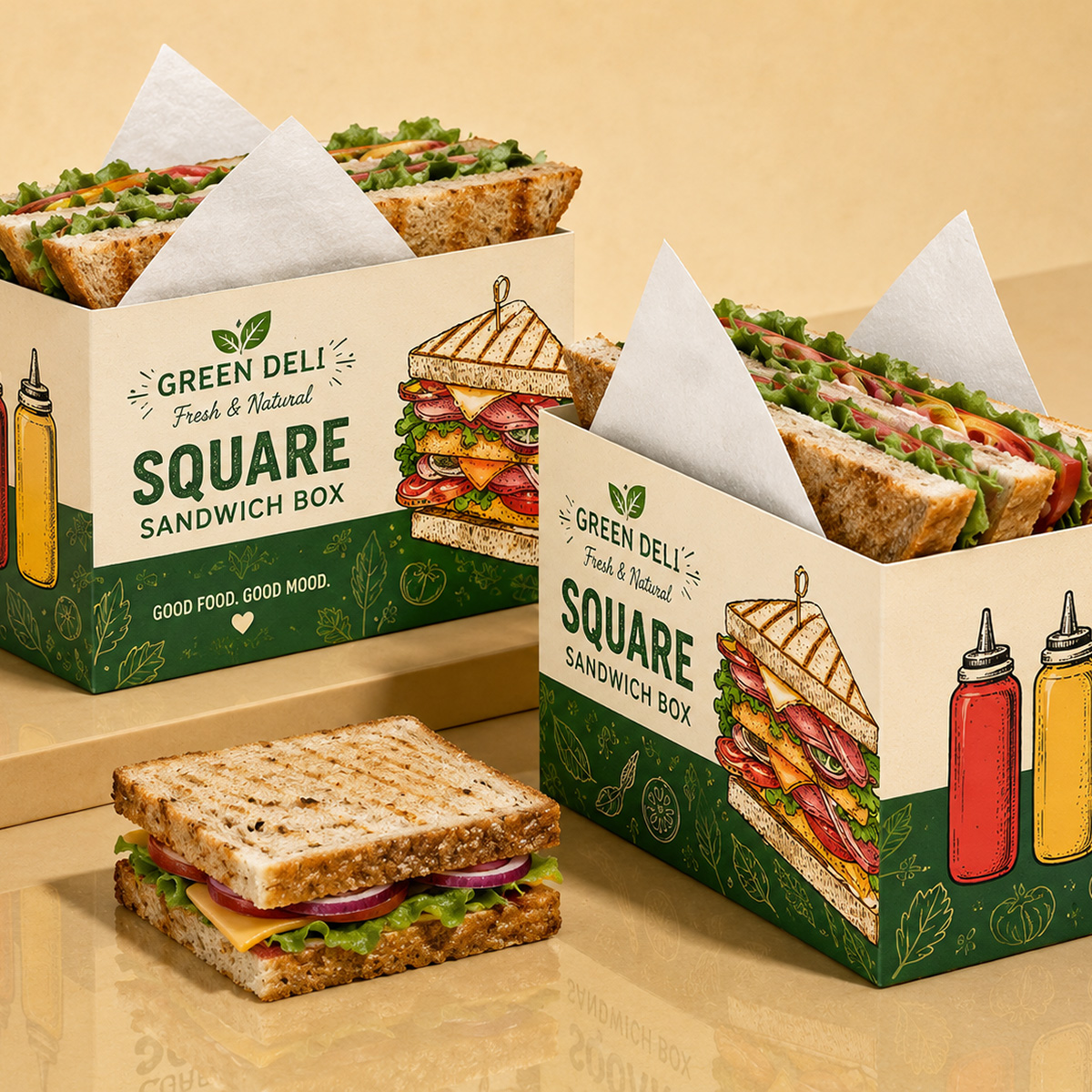
Our cardboard sandwich boxes and kraft sandwich boxes are manufactured to suit the specific sandwich format, service context, and brand requirements of your business. From disposable sandwich boxes for high-volume cafe service to premium sandwich box packaging for catering and gifting, we’ve been supplying cafe and food-to-go packaging to Australian businesses since 2017.
Get in touch today to discuss your requirements or request a quote.


Order Process
We quote on the box style of your choice
We receive your final design on a die line template
We send you an invoice to pay
We send you 3D mockups to confirm and start production
We ship the order to you by air or by sea
Request a Quote
To request an accurate quote from us, please fill out the form below. If you have any questions about using this form, please send an email to [email protected]
Sandwich Box Styles We Offer
We manufacture custom sandwich boxes across a range of styles to suit different sandwich formats and service contexts. All styles are available in custom sizes, materials, and finishes.
Classic Sandwich Boxes
The standard format for square or rectangular sandwiches – a flat, shallow box with a secure lid that closes cleanly and holds the sandwich during transport without compressing it. Available in dimensions to suit standard sandwich sizes, from a single slice through to a double-decker or club sandwich configuration.
The interior height of the box needs to accommodate the full height of the sandwich without the lid pressing down on the top slice – a lid that compresses the sandwich will distort the bread and cause fillings to be pushed out the sides. For generously filled sandwiches, the lid clearance specification is as important as the footprint dimensions.
Wedge Sandwich Boxes
A format specifically for diagonally cut sandwiches – the triangular half-sandwich format that’s standard in most Australian cafe and deli retail. Wedge sandwich containers hold the triangular sandwich wedges upright, with the cut face visible through a window panel, in a compact format that’s easy to pick up and carry.
The wedge format is efficient for display – a row of wedge sandwich boxes in a cafe refrigerator creates an immediate visual impression of the filling variety across the range. The cut face of the sandwich – showing the layered ingredients in cross-section – is one of the most effective visual selling tools in sandwich retail, and a window configuration that shows it clearly communicates the quality and generosity of the filling at the point of sale.
Sub and Roll Boxes
A format for longer sandwich formats – submarine rolls, baguettes, and bread rolls with fillings. These products are longer and narrower than a standard sandwich, and the box needs to match that format. A standard square sandwich box that’s too short for a baguette forces the product to be cut or the box to be left open – neither of which is a good outcome.
Available in lengths to suit standard roll and baguette sizes, with secure end closures that prevent the roll from sliding out during transport. For rolls and subs with generous fillings, the lid height specification needs to accommodate the full height of the filled roll without compression.
Window Sandwich Boxes
A window panel that shows the sandwich before the box is opened – typically showing either the cut face of a diagonal sandwich or the top surface of a filled roll. For sandwiches where the visible filling is the primary selling point, a window does more to communicate the quality and appeal of the product than print on the exterior panel.
Window placement for sandwich boxes typically works best showing the cut face for diagonal sandwiches, or a top panel window for rolls and whole sandwiches where the visible cross-section or top layer communicates the filling. The window should be sized to show the most visually compelling part of the product.
Toasted and Hot Sandwich Boxes
A format specifically designed for toasted sandwiches, paninis, and hot filled rolls. Hot sandwich packaging has two specific requirements that cold sandwich packaging doesn’t: heat resistance in the base and walls, and ventilation to prevent the steam from the hot bread from condensing inside the box and making the bread soggy.
Available with ventilation perforations, heat-resistant materials, and construction that allows some airflow without the sandwich cooling too rapidly. For cafes that serve both hot and cold sandwiches, having a separate box specification for each – rather than a compromise format that serves neither optimally – is worth the additional specification effort.
Choosing the Right Sandwich Box Configuration
The configuration decisions for sandwich packaging depend primarily on the sandwich format, whether the product is hot or cold, and the service context.
Sandwich cut determines the box format. A square-cut sandwich, a diagonal cut, a roll, and a baguette all have different shapes that require different box configurations. The box needs to match the shape of the sandwich – not just approximately, but precisely enough that the sandwich sits correctly without being able to move laterally within the box. A diagonal sandwich in a box that’s too wide will tilt and present poorly; a roll in a box that’s too short will have the ends exposed.
Filling height is consistently underestimated. Sandwich filling height varies enormously – from a thin layer of spread on a simple sandwich to a substantial stack of multiple fillings on a club sandwich or a loaded roll. The lid height needs to be specified for the maximum filling height of the product as served, not the average. A lid that compresses a thick sandwich will push the fillings out the sides and distort the bread. For cafes with multiple sandwich configurations at different heights, it’s worth considering whether one box format can serve all of them or whether a tall and standard lid option is needed.
Hot vs cold construction. A cold sandwich needs packaging that maintains freshness and manages moisture migration from the filling to the bread over the expected holding period. A hot toasted sandwich needs packaging that resists heat, allows steam to escape, and maintains the structural integrity of the box when the base is hot. These are different material requirements. A box specified for a cold chicken and salad sandwich is not the right specification for a hot Reuben or a grilled panini.
Assembly speed in peak service periods. Morning peak service in a cafe is one of the highest-pressure food service environments – orders are coming in at high volume, multiple products are being prepared simultaneously, and there’s no time to waste on packaging that’s slow to assemble or difficult to close. For sandwich boxes used in a cafe service context, the time to fold and close the box – and the reliability of the closure under the weight of the sandwich – are practical requirements that affect the operational efficiency of the business during its most critical trading period.
Sandwich-Specific Considerations
A few properties of sandwiches that create packaging requirements specific to this product.
Bread absorbs moisture and softens quickly. The bread in a sandwich is porous and hygroscopic – it absorbs moisture from the filling, from the environment, and from any steam produced by a warm filling or a toasted bread. Keeping sandwiches fresh requires packaging that balances moisture management with adequate enclosure. For sandwiches with a longer shelf life – retail sandwiches that may sit in a refrigerator for hours before purchase – eco friendly, recyclable materials with appropriate moisture management properties protect the bread texture that the consumer ultimately experiences.
Compression is the most common structural failure. A sandwich under its own weight, or under the weight of other items placed on top of it during transport, will compress. Compression pushes the fillings out the sides, distorts the bread, and produces a sandwich that looks significantly less appealing than when it was made. The lid of the sandwich box needs to resist downward compression – it should be rigid enough that moderate pressure from above doesn’t transmit to the sandwich. For delivery applications where the sandwich box may be placed under other items in a delivery bag, this is a real practical requirement.
Filling leakage is a presentation and packaging integrity problem. Sauces, condiments, and moist fillings – coleslaw, sliced tomato, dressed leaves – produce liquid that migrates to the base of the box over time. A base that’s not liquid-resistant will become saturated and structurally compromised. The join between the base and the walls is the most common leak point for this kind of moisture. Liquid-resistant materials on the base and lower walls, and tight construction at the base-wall join, are worth specifying for sandwiches with liquid-producing fillings.
Toasted sandwich steam management. A freshly toasted sandwich or panini produces steam from the hot bread. Sealed in an airtight box, that steam condensates on the interior and falls back onto the bread – re-moistening the surface that was just made crisp by toasting. Ventilation perforations in the lid or walls allow steam to escape without the sandwich cooling too rapidly. The amount of ventilation needed depends on the temperature of the sandwich at the point of boxing and the expected time before consumption – a sandwich that’s going to be eaten in two minutes needs less ventilation than one that’s going to be carried for fifteen minutes.
Cafe morning peak service creates extreme assembly speed requirements. A busy city cafe during the 7am to 9am rush is handling a very high volume of orders simultaneously, with minimal time between orders. Sandwich boxes in this context are assembled and filled at high speed – a box that takes five seconds to fold correctly instead of two seconds is a meaningful operational cost over the course of a morning peak. Box formats that pre-fold, self-lock without needing to be held, and close cleanly with one hand are commercially valuable in this context.
Delivery platform growth has changed sandwich packaging requirements. A significant and growing proportion of cafe sandwich sales goes through food delivery platforms. A sandwich packaged for a counter handover – a cardboard box closed with a simple tuck-top – may not hold up well after fifteen to thirty minutes in a delivery bag, particularly if the bag is placed on its side or the box is under other items. For cafes with a significant delivery component, the packaging specification for delivery sandwiches should be treated as a separate brief from the counter handover specification.
Print & Finishing for Sandwich Boxes
Sandwich packaging sits in the cafe and fresh food market, where brand identity and practical function are both important.
Cafe branded sandwich packaging needs to communicate the brand clearly and consistently across multiple sandwich formats. A consistent logo, brand colour, and print treatment across the wedge box, the roll box, and the toasted sandwich box creates a unified brand impression. Every element can be customised – size, material, finish, and print. Embossing on the logo adds a tactile quality that elevates the brand impression for premium cafe and catering applications. Full colour printing in CMYK on a kraft or white base stock is the standard approach.
Window and display design. For wedge sandwich boxes in particular, the window is the primary display feature – the visible cross-section of the sandwich is what sells the product in a refrigerator display. The printed areas of the wedge box should frame and direct attention to the window, not compete with it. A clean design that highlights the brand and the window configuration is more effective than a heavily printed box that obscures the product.
Health food and premium sandwich branding. For cafes and sandwich businesses positioned at the premium or health-conscious end of the market, the packaging design should reflect that positioning – clean, ingredient-forward communication, natural materials, and a restrained design approach that communicates quality rather than convenience. A premium grain bread sandwich with house-made fillings deserves packaging that matches its positioning.
All boxes are printed using full colour printing in CMYK. Files should be supplied as Adobe Illustrator (.ai) or high-resolution print-ready PDF, with fonts outlined and graphics embedded. Free design support is included – we’ll produce a free 3D mockup for your approval before production begins, and handle minor artwork adjustments at no extra charge. Free dieline templates are available if you’re building your artwork from scratch.
Materials & Specifications
We manufacture sandwich boxes in a full range of cardboard and paperboard materials, with moisture resistant and grease resistant options for products with liquid-producing fillings, and heat-resistant options for toasted sandwich applications. Compostable and biodegradable options are available for cafes with sustainability requirements. All materials are food grade and food safe.
- Single copper paper
- White kraft
- Brown kraft
- Black kraft
- Gold foil paper
- Silver foil paper
- Corrugated board
Minimum order quantity is 1,000 units. Air freight runs approximately 3 – 4 weeks from production sign-off; sea freight is approximately 8 weeks. We supply cafes and food businesses across Australia including Sydney, Melbourne, and Brisbane. For more detail on the full order process, artwork requirements, and lead times, get in touch and we’ll walk you through it.
Join our newsletter for 10% off your first order
Get our emails for info on new items, sales and much more.

Vivo Packaging Pty Ltd
Aussie Warehouse:
4 Tasman Ct, Keysborough VIC 3173, Australia
Monday – Friday: 9.30am – 5.30pm
Visitors By Appointment Only

Need Help?
Copyright 2026 © VIVO CUSTOM BOXES. ALL RIGHTS RESERVED.