
Custom Salad Boxes
Salad packaging has to solve problems that most other food packaging doesn’t face simultaneously. The product needs to stay fresh, the dressing needs to stay separate until the consumer is ready to eat, the ingredients need to stay in their arranged positions rather than tumbling into a homogenous mix, and the whole thing needs to be leak-proof enough that the dressing doesn’t migrate through the box during transport. And it needs to do all of that while showcasing the visual appeal of the salad itself – because the colour, the arrangement, and the visible variety of ingredients is a primary selling point for any well-made salad.
The salad market in Australia has grown significantly across multiple channels – office lunch delivery, health food retail, cafe counter service, and food delivery platforms all contribute to a category that’s more sophisticated and demanding than it was a decade ago. Consumers buying salads are health-conscious, visually engaged, and paying attention to ingredient quality. The packaging needs to match those expectations.
Our custom salad containers and salad boxes are manufactured to suit the specific product format, service context, and brand requirements of your salad range – fully customisable in size, material, and finish to suit everything from simple vegetable salads through to complex grain bowls and composed salad platters. We’ve been supplying fresh food packaging to Australian food businesses since 2017.
Get in touch today to discuss your requirements or request a quote.


Order Process
We quote on the box style of your choice
We receive your final design on a die line template
We send you an invoice to pay
We send you 3D mockups to confirm and start production
We ship the order to you by air or by sea
Request a Quote
To request an accurate quote from us, please fill out the form below. If you have any questions about using this form, please send an email to [email protected]
Salad Box Styles We Offer
We manufacture custom salad boxes across a range of styles to suit different products and service contexts. All styles are available in custom sizes, materials, and finishes.
Classic Salad Boxes
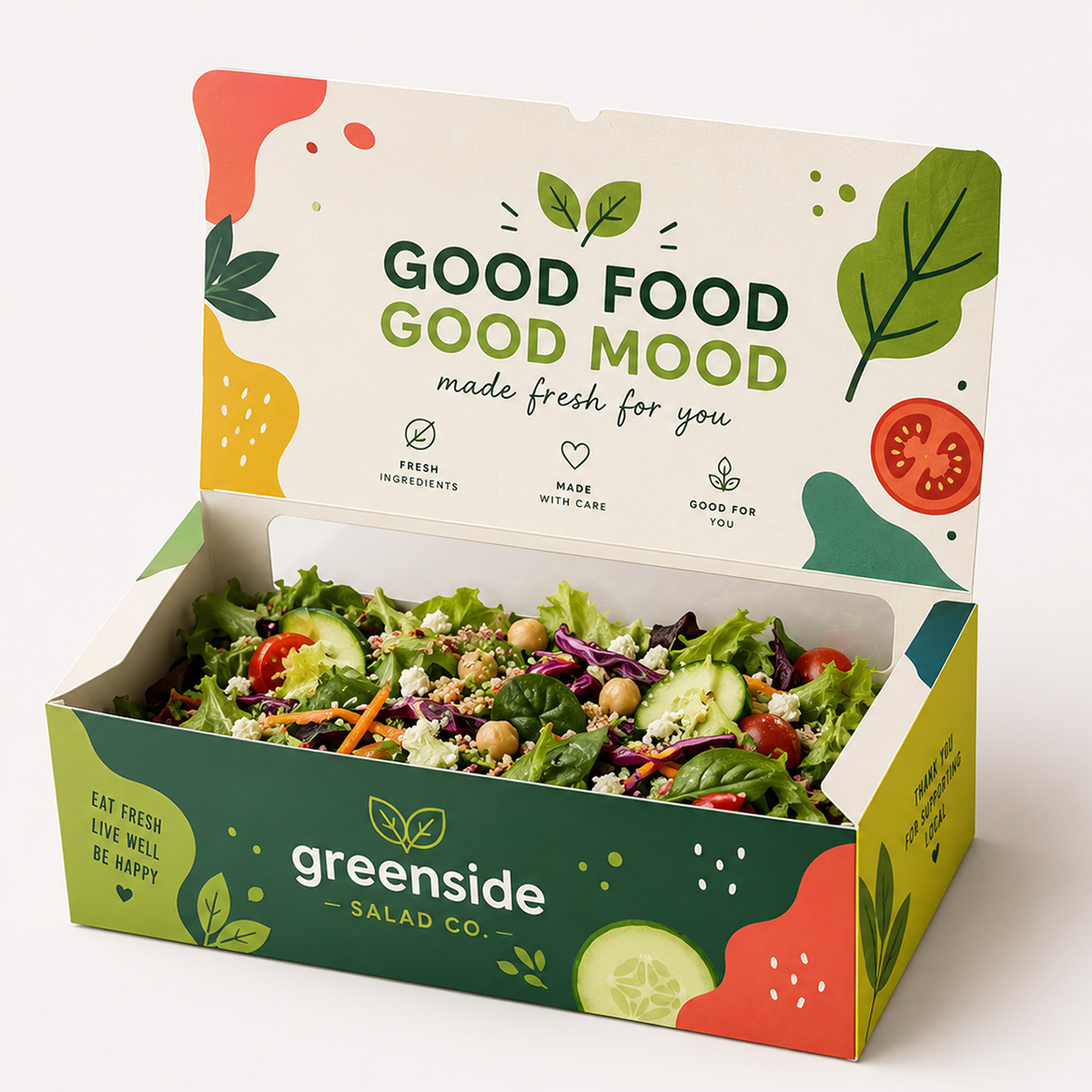
The standard format for salads sold through cafes, delis, and health food retailers. A classic salad box is a flat or shallow rectangular or square container with a secure lid that closes cleanly and holds the product during transport without spilling. The interior needs to hold the salad without the ingredients being compressed, and the base needs to be moisture resistant to handle the water content of fresh vegetables and dressing.
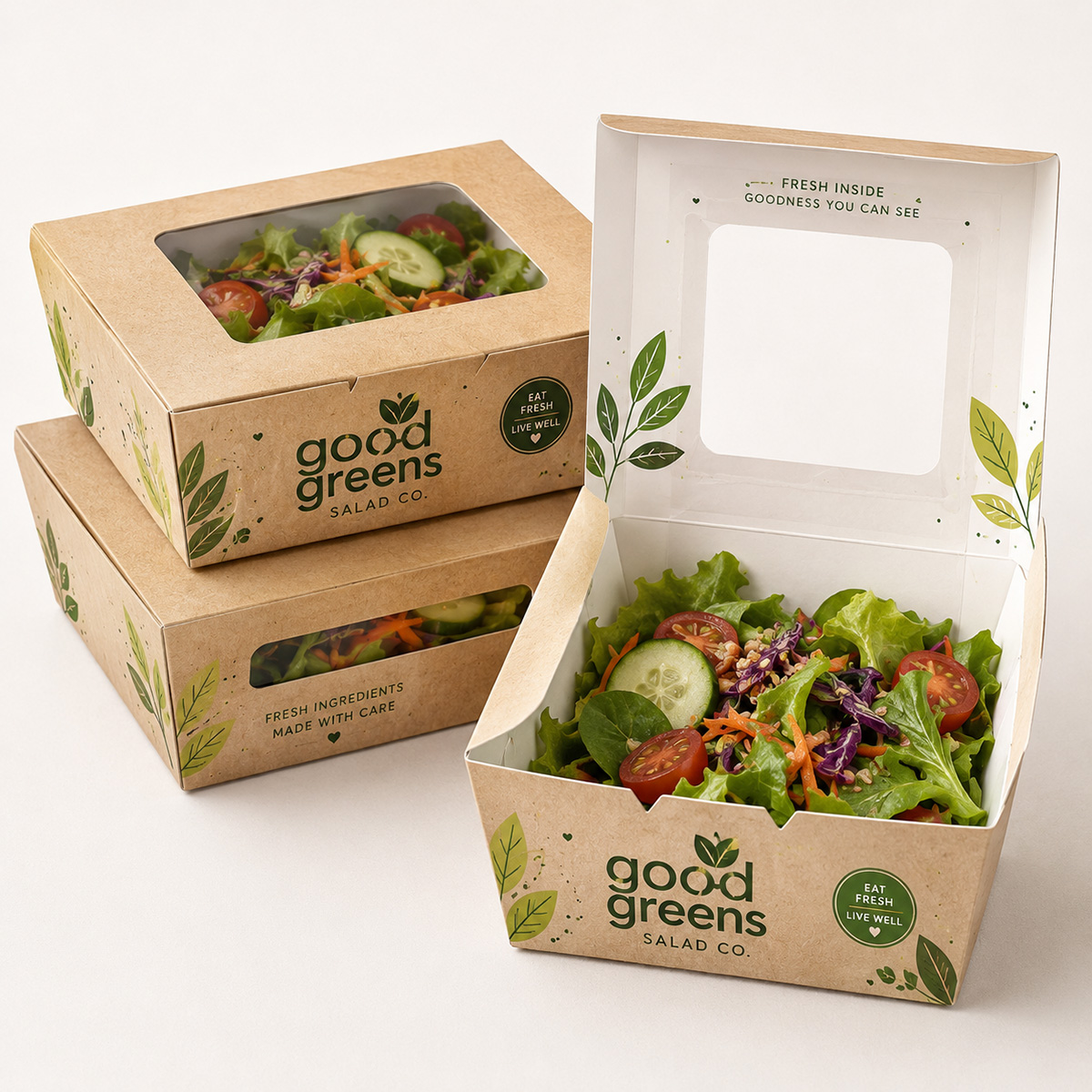
Available in a range of sizes to suit different portion sizes, from individual lunch serves through to larger sharing portions. The exterior print surface communicates the brand and the product, and window options allow the salad inside to be visible at the point of sale.
Window Salad Boxes
A window configuration that allows the salad to be seen before the box is opened. For salads where the arrangement of ingredients – the colour variety, the visible proteins or toppings, the overall composition – is a primary selling point, a window does more to communicate the quality and appeal of the product than print alone.
Window placement for salad boxes typically works best as a full-face lid window or a large top panel, showing the complete arrangement of the salad as it’s presented. The window should be sized to show the full salad, not just part of it – a partial window that shows the edge of the salad but not the complete composition is less effective than no window at all.
Compartment Salad Boxes
A format with two or more interior compartments that keep different ingredients or components separated until the consumer is ready to combine them. Compartment salad boxes are used for salads where ingredient separation is important – keeping dressing away from leafy greens, keeping hot components away from cold ones, or keeping wet ingredients away from dry ones.
The most common application is a main salad compartment with a separate smaller compartment for dressing. This configuration keeps the salad fresh for longer, prevents the dressing from wilting the greens during transport, and gives the consumer control over how much dressing they use. For salads sold through retail or meal delivery where the time between packaging and consumption may be hours rather than minutes, compartment separation is a practical and product quality consideration.
Grain Bowl Boxes
A format for grain bowls, noodle salads, and other bowl-format fresh food products. Grain bowls – combinations of grains, proteins, vegetables, and sauces – are one of the fastest-growing fresh food formats in Australian cafe and health food retail, and the packaging needs to suit the deeper, rounder profile of a bowl-format product rather than the shallow profile of a flat salad.
Available in cylindrical and square bowl formats, with secure lids that hold the contents at the right height without compressing the toppings. The visual impact of a well-composed grain bowl is significant, and window lids or clear-lid formats that show the complete bowl are common in the premium health food retail segment.
Salad Gift Boxes
A premium format for health food gifting – a curated selection of salad components, a meal kit, or a fresh food collection presented as a gift. Salad gift boxes are a niche but growing format in the corporate wellness gifting and health-conscious personal gifting market.
The packaging needs to present as a considered health gift – clean, premium, and communicating the quality of the fresh ingredients inside. Insulated formats may be necessary to maintain the freshness of the contents for the duration of the gifting experience.
Choosing the Right Salad Box Configuration
The configuration decisions for salad packaging depend on the product format, the dressing arrangement, and the service or delivery context.
Dressing separation is a functional requirement for most salad formats. A salad dressed before packaging will have wilted, soggy greens by the time it reaches the consumer if there’s any significant delay between packaging and consumption. For salads sold through delivery platforms, retail, or any channel where the consumption time is more than fifteen to twenty minutes after packaging, keeping the dressing separate preserves the texture and freshness of the product. The most practical solution is a separate dressing container – either a small pot included inside the box, or a separate compartment within the box design. The box needs to accommodate the dressing container securely so it doesn’t tip during transport.
Ingredient height affects lid clearance requirements. A flat dressed salad has minimal height above the base. A composed grain bowl or a salad with substantial toppings – avocado halves, a boiled egg, a tall stack of garnishes – can be significantly higher. The lid needs to close without compressing the toppings, which requires either adequate lid clearance or a dome lid format for taller configurations. A lid that compresses the toppings damages the presentation and, for delicate items, the product itself.
Moisture management is a two-sided problem for salad packaging. Fresh vegetables release moisture, and that moisture needs somewhere to go – but it shouldn’t saturate the base of the box or migrate through the packaging. A completely sealed box traps the moisture and creates a humid interior that accelerates the deterioration of the product. Some degree of moisture management – either through a moisture-absorbent liner in the base, micro-ventilation in the lid, or a material that manages moisture migration – extends the freshness of the product beyond what a plain sealed box achieves.
Cold salads need refrigerator-compatible materials. Salads sold through refrigerated retail, meal delivery services, or any channel where the product is stored in a refrigerator before consumption need packaging that maintains its structural integrity and print quality in cold, humid conditions. Standard paperboard that performs well at ambient temperature may soften and lose its structure in a refrigerator environment over an extended holding period. For salads with a multi-day shelf life in retail refrigeration, the material specification needs to account for extended cold and humid exposure.
Salad-Specific Considerations
A few properties of salads as a product that create specific packaging requirements.
Leak prevention is the most fundamental requirement. A salad box that leaks dressing or vegetable moisture is a product failure regardless of the quality of the salad inside. The base and walls of the box need to be liquid-resistant to the moisture content and acidity of the dressing and the vegetables. For salads with oil-based dressings, grease resistance is also relevant. The join between the base and the walls, and between the lid and the box body, are the most common leak points – the box construction needs to close these joints cleanly with no gaps that allow liquid to escape.
Colour and arrangement are the primary selling points. A well-made salad is visually compelling – the combination of colours from different vegetables, proteins, grains, and garnishes creates an immediate and appealing visual impression. This visual quality is the first and often the deciding factor in a salad purchase, particularly in a cafe counter display or a health food retail environment. Packaging that hides the salad – an opaque lid on a beautifully composed grain bowl – removes the most compelling selling point from view at exactly the moment it’s most needed. Window formats and clear lid options leverage the visual quality of the product at the point of sale.
The health food consumer pays attention to packaging sustainability. Salad consumers are disproportionately health-conscious and environmentally aware. Single-use plastic lids on salad boxes are increasingly unpopular with this consumer group, and cafes and health food businesses that use sustainable or compostable packaging materials communicate a values alignment that matters to this market. The material choice for salad packaging is a brand statement as much as a functional decision.
Delivery platform compatibility. A significant portion of cafe and restaurant salad sales now goes through food delivery platforms – Uber Eats, DoorDash, and similar services. A salad packaged for a counter handover will not necessarily hold up equally well after fifteen to thirty minutes in a delivery bag. For salads sold through delivery channels, the packaging specification needs to account for the additional time and handling of delivery – a more secure lid closure, better moisture management, and a more robust base construction are all worth specifying for delivery-intended products.
Portion size communication. Salads are often sold at a price point where the portion size is a significant value consideration – a consumer choosing between a $14 and an $18 salad is partly making a judgment about relative portion sizes. The packaging needs to communicate the portion clearly – either through the visible size of the box, a window that shows the volume of the salad, or clear weight or serve labelling on the exterior. Packaging that makes a generous salad look small is a commercial disadvantage; packaging that presents the salad at its full volume is a commercial asset.
Print & Finishing for Salad Boxes
Salad packaging sits in the health food and fresh food market, and the print and finishing approach needs to reflect that positioning.
Health food and fresh food packaging communicates through clean design, natural colour palettes, and ingredient-forward visual language. The packaging design should make the salad look fresh and appetising – which typically means a design that doesn’t compete with the product visually. A clean, minimal box with a window that shows the salad is often more effective than a heavily printed box that obscures the product.
Window and packaging design relationship. For window salad boxes, the printed areas of the box should frame and complement the visible salad rather than compete with it. The salad itself is the visual centrepiece – the packaging design should support and elevate that impression, not detract from it. A well-designed salad box with a full-face window creates an immediate product impression that no amount of food photography on the exterior panel can replicate.
Cafe and delivery branding. For cafes and restaurants with a strong brand identity, the salad box is a brand impression that travels with the consumer. A consistently branded salad box – in the brand’s colour palette, with the logo clearly placed – extends the cafe’s brand presence into the consumer’s workplace or home. For delivery platform sales, the branded box is the primary physical brand touchpoint the consumer receives with their order.
All boxes are printed using full colour printing in CMYK. Files should be supplied as Adobe Illustrator (.ai) or high-resolution print-ready PDF, with fonts outlined and graphics embedded. Free design support is included – we’ll produce a free 3D mockup for your approval before production begins, and handle minor artwork adjustments at no extra charge. Free dieline templates are available if you’re building your artwork from scratch.
Materials & Specifications
We manufacture salad boxes in a full range of cardboard and paperboard materials, with moisture resistant and liquid resistant options for fresh food applications. Compostable and biodegradable options are available for businesses with sustainability requirements. All materials are food grade and food safe.
- Single copper paper
- White kraft
- Brown kraft
- Black kraft
- Gold foil paper
- Silver foil paper
- Corrugated board
Minimum order quantity is 1,000 units. Air freight runs approximately 3 – 4 weeks from production sign-off; sea freight is approximately 8 weeks. We supply cafes and fresh food businesses across Australia including Sydney, Melbourne, and Brisbane. For more detail on the full order process, artwork requirements, and lead times, get in touch and we’ll walk you through it.
Join our newsletter for 10% off your first order
Get our emails for info on new items, sales and much more.

Vivo Packaging Pty Ltd
Aussie Warehouse:
4 Tasman Ct, Keysborough VIC 3173, Australia
Monday – Friday: 9.30am – 5.30pm
Visitors By Appointment Only

Need Help?
Copyright 2026 © VIVO CUSTOM BOXES. ALL RIGHTS RESERVED.