
Custom Croissant Boxes
Croissants are one of the most shape-specific products in the bakery category. The crescent form – wide at the wingtips, tall at the centre, tapering to points at each end – doesn’t fit neatly into a standard rectangular box, and the laminated pastry structure means any pressure on the product causes visible damage. A box that’s sized to the approximate diameter of a croissant, rather than to its actual wingtip-to-wingtip measurement, will catch the tips on closing and crush the layers at the ends. Getting the dimensions right is the first and most important step in croissant packaging.
Our custom croissant packaging boxes are manufactured to the actual dimensions of your specific product – wingtip width, centre height, and length – with lid clearance that protects the layered structure of these baked goods throughout transport. We’ve been supplying custom croissant packaging to Australian cafes, patisseries, and catering businesses since 2017.
Get in touch today to discuss your requirements or request a quote.
Order Process
We quote on the box style of your choice
We receive your final design on a die line template
We send you an invoice to pay
We send you 3D mockups to confirm and start production
We ship the order to you by air or by sea
Request a Quote
To request an accurate quote from us, please fill out the form below. If you have any questions about using this form, please send an email to [email protected]
Choosing the Right Croissant Box Configuration
The configuration decisions for croissant packaging are more shape-driven than for most other bakery products, because the irregular geometry of a croissant affects almost every dimension of the box.
Measure wingtip to wingtip, not across the centre. The widest point of a croissant is the span from one wingtip to the other, which is significantly wider than the body of the product. A box sized to the body width will catch the tips on closing – which crushes the most fragile part of the croissant. The interior width of the box needs to accommodate the full wingtip span with a small clearance on each side to prevent contact with the box walls during transport.
Centre height determines lid clearance. The tallest point of a croissant is the centre peak, where the layers arch upward. The lid needs to clear this peak without contact – even light pressure from a lid compresses the layers and damages the texture. Measure the height of your tallest croissant, not the average, and specify the interior lid height with a few millimetres of additional clearance above that measurement.
Single croissant vs multi-croissant arrangement. A single croissant in a box is the standard cafe retail format – the box is sized to one product with adequate clearance on all sides. For multi-unit configurations, the arrangement of the croissants matters. Parallel arrangement – all croissants pointing in the same direction – requires a longer box but allows each product its own space. Alternating arrangement – tips to tails in adjacent rows – is more space-efficient but requires careful clearance management to prevent the tips of one croissant contacting the body of the next.
Filled vs plain croissants have different weight and height profiles. A plain butter croissant is lighter and has a clean arched profile. A filled croissant – almond, chocolate, ham and cheese, or any cream or jam filling – is heavier, may have a slightly different shape depending on how it’s filled, and in some cases has filling visible at the ends that needs clearance from the box walls. The base of a multi-unit box holding filled croissants needs to be specified for the higher load weight.
Takeaway single format vs catering bulk. A cafe selling individual croissants at a counter needs a single-unit box that’s quick to assemble, easy to hand over, and compact enough to fit on a counter. A catering operation delivering twenty or thirty croissants to an office needs a multi-unit box that holds the products securely, stacks safely, and can be transported without individual boxes shifting during vehicle movement. These are different briefs that typically need different packaging solutions.
Croissant Box Styles We Offer
We manufacture custom croissant boxes across a range of styles to suit different products and sales contexts. All styles are available in custom sizes, materials, and finishes.
Single Croissant Boxes
The primary format for cafe retail and individual takeaway. A single croissant box needs to be quick to assemble during a busy service period, hold the croissant securely without contact damage, and represent the brand at the point of handover to the customer.
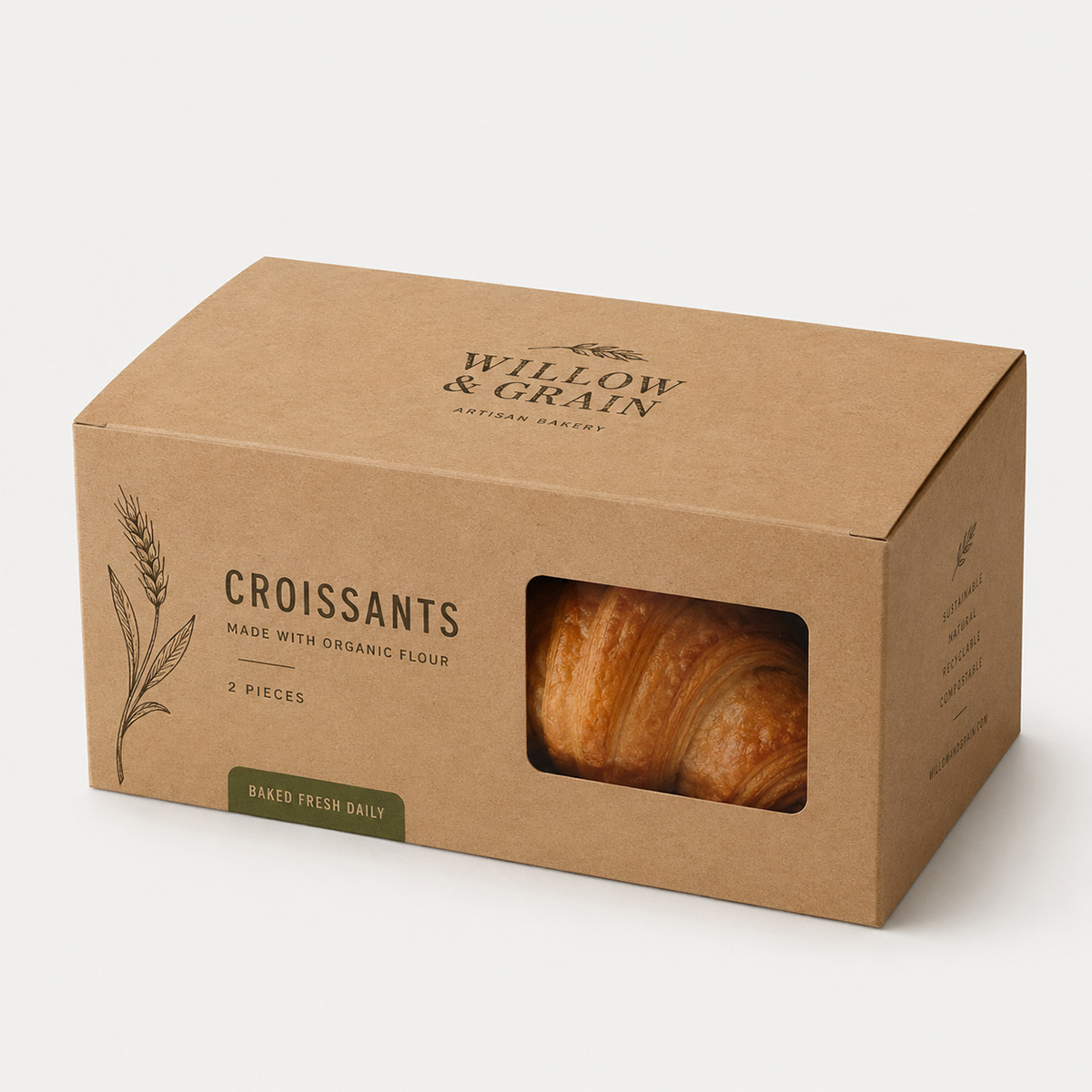
Available with window panels to show the layered profile and the golden colour of the crust, in dimensions configured to the specific product measurements, and with a range of closure styles to suit different service environments. For cafes where croissants are a high-volume daily product, assembly speed is a practical consideration – the box format needs to be one that staff can prepare quickly without disrupting service flow.
Multi-Croissant Boxes
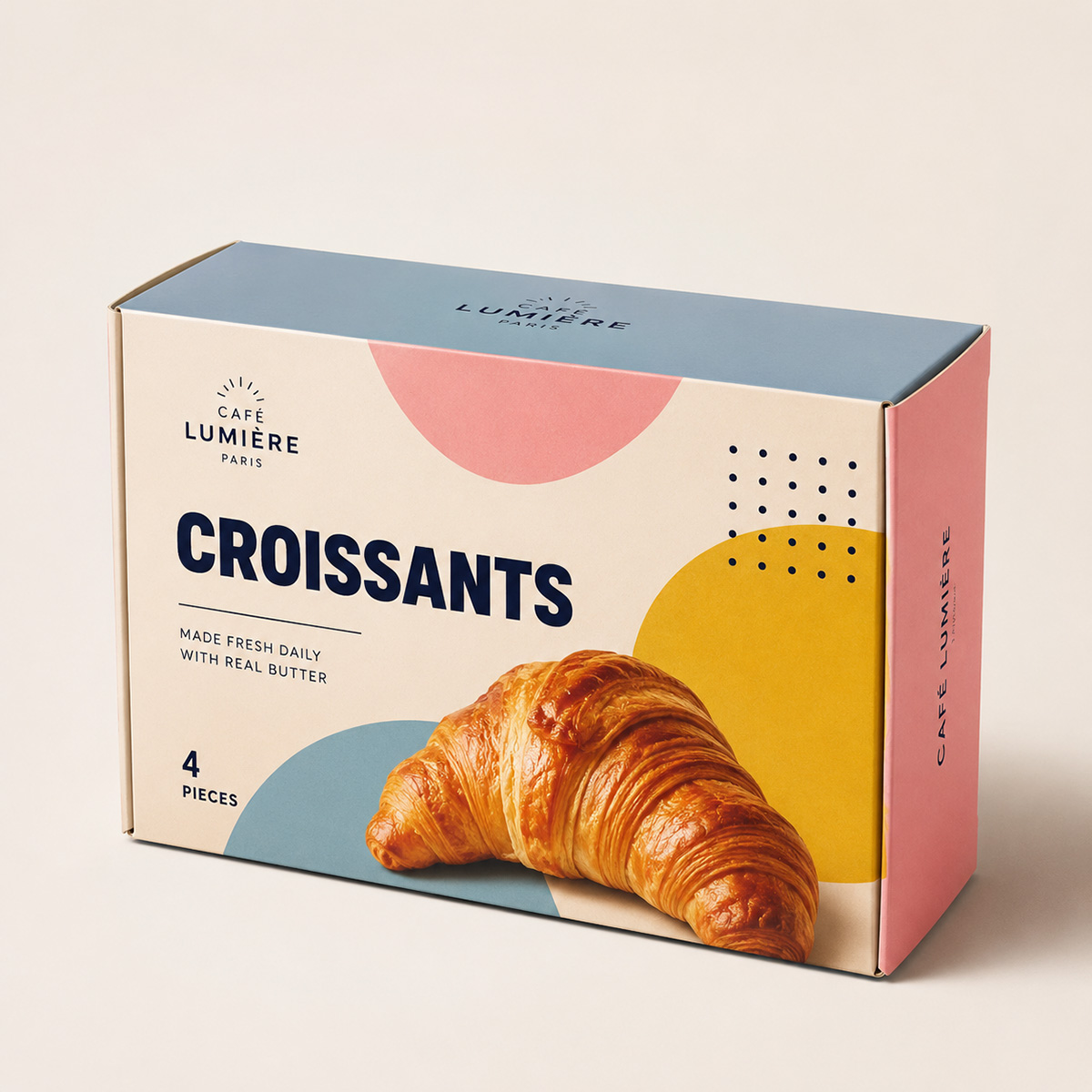
Two, four, and six-unit configurations for catering orders, corporate breakfast delivery, and wholesale supply. The interior configuration needs to hold each croissant in position with adequate clearance between products – tip contact between adjacent croissants in a multi-unit box is a common damage source that a well-designed insert or compartment arrangement prevents.
Multi-croissant boxes for catering applications need a base construction robust enough to support the combined weight of the product over the transport distance involved. For large catering orders, a corrugated base or a double-wall construction is worth the additional cost to prevent base failure during delivery.
Window Croissant Boxes
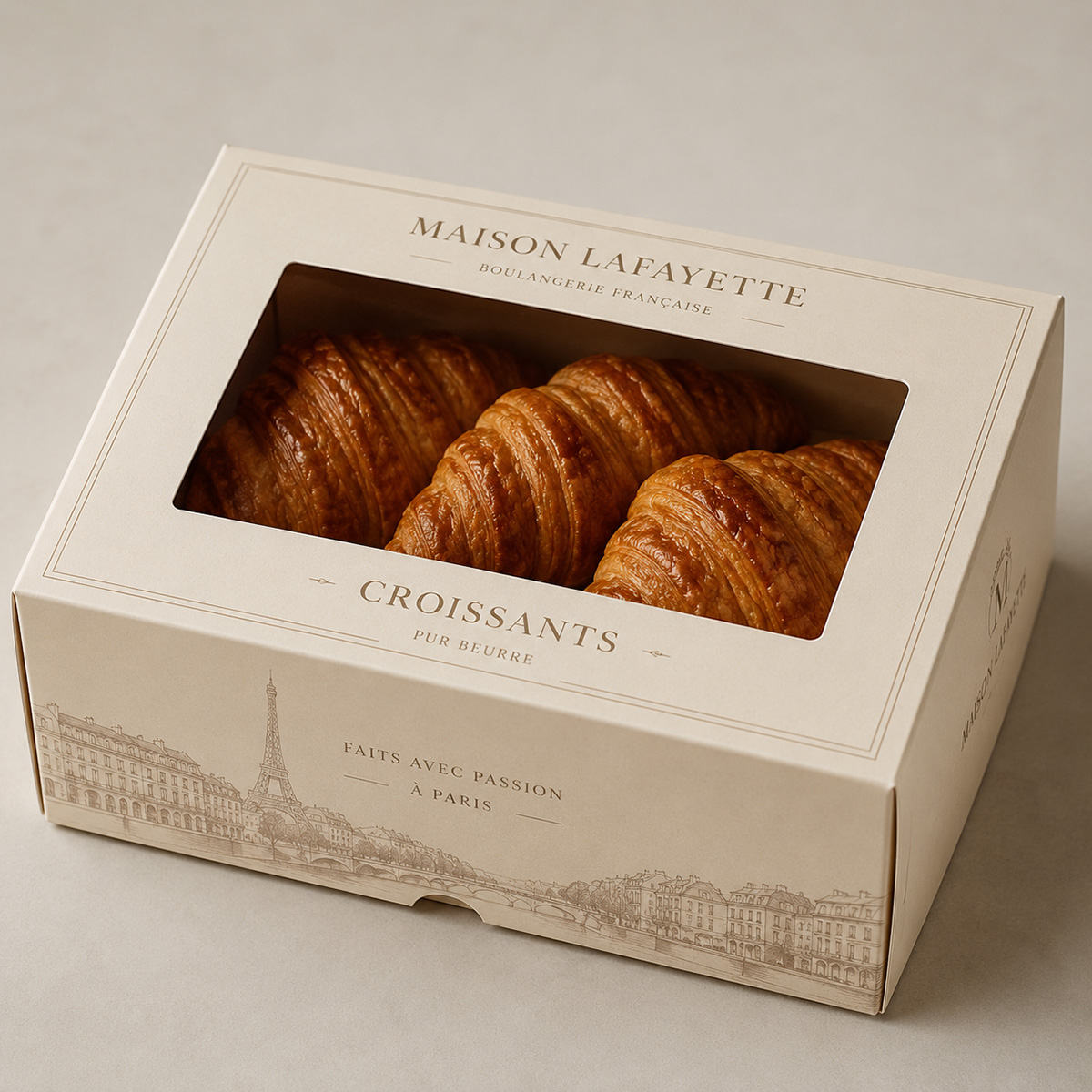
A window on a croissant packaging box showcases the layers, the colour, and the form of the product before the box is opened. The cross-section of a well-laminated croissant – visible through a side or front panel window – is one of the most visually compelling images in bakery retail, and a window configuration that showcases it does a lot of the selling work at a cafe counter or patisserie display. It also gives customers confidence in the freshness of the product at the point of purchase.
For single croissant boxes, a full-front window or a top panel window are both effective configurations. For multi-unit boxes, a full-face lid window or a large front panel window shows the complete arrangement of the products inside.
Croissant Gift Boxes
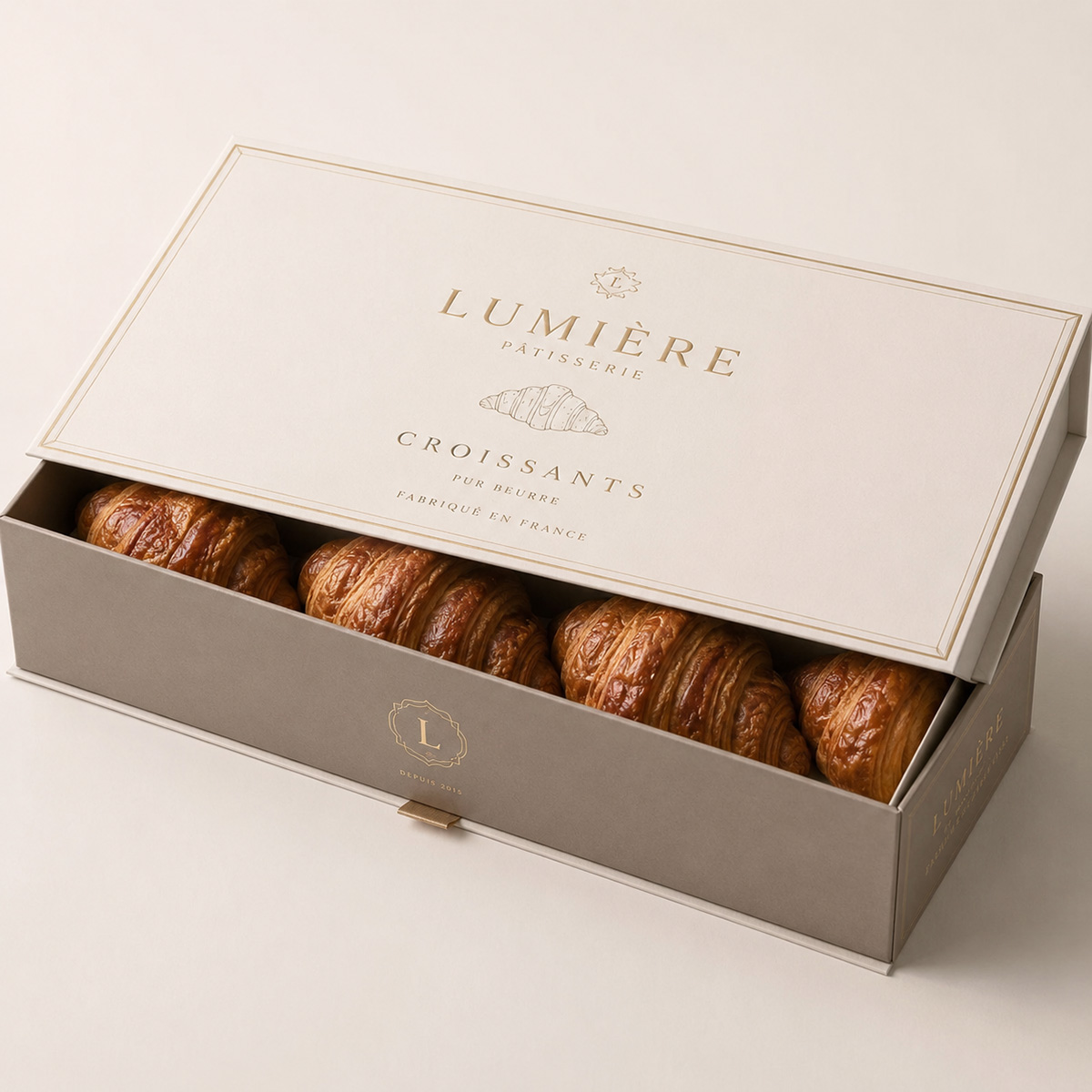
Used for premium patisserie gifting, breakfast hamper components, and high-end catering presentation. A croissant gift box needs the structural integrity to protect the products through transport and the exterior finish to present as a considered gift or premium food item.
Common applications include weekend breakfast gift boxes, patisserie morning gift sets paired with jams and butter, and corporate breakfast gifting. The finish and construction should reflect the premium positioning – a gift box of fresh croissants from a quality patisserie warrants a box that matches the quality of the product inside.
Catering and Bulk Croissant Boxes
A high-volume format for corporate catering, event supply, and wholesale delivery. Structural robustness and efficient volume are the primary requirements. These boxes need to be sturdy and durable enough to hold a large number of croissants securely, stack safely in a vehicle or catering kitchen, and withstand the handling conditions of a commercial delivery environment. Durability across repeated handling is as important as the initial box construction.
Print requirements for catering formats are typically simpler – a brand mark and product identification. The priority is consistent structural performance across large volumes rather than premium retail finish.
Croissant-Specific Considerations
A few properties of croissants that create packaging requirements specific to this product.
The wingtips are the most fragile point. The tapered ends of a croissant are where the pastry is thinnest and the layers are most exposed. Any contact between the wingtip and a hard surface – the box wall, another croissant, a lid that closes too far – will crack the tip. This is the most visible form of croissant packaging damage and it’s entirely preventable with the right box dimensions. The interior width of the box must accommodate the full wingtip span; the interior length must accommodate the full length of the croissant with clearance at each pointed end.
Laminated pastry cannot bear vertical pressure. The hundreds of thin butter layers in a croissant are what create the texture and the visual cross-section. Any downward pressure – from a lid that’s too low, from a stacked item, from a hand pressing the box closed – will compress those layers and destroy the structure of the product. The lid must clear the top of the croissant without contact under any handling condition. This is a zero-tolerance requirement for a premium croissant product.
Steam from hot croissants destroys crispness. A freshly baked croissant sealed in a closed box retains its own steam, which condensates inside the box and softens the exterior crust. A croissant that arrives with a soft, slightly damp exterior rather than a crisp, flaky one is a product quality failure, regardless of how good the pastry was when it was baked. Ventilated box designs – perforated panels, vented lids, or partially open formats – allow steam to escape without the croissant cooling too rapidly. For any business selling or delivering freshly baked croissants, ventilation is a product quality requirement, not a nice-to-have.
The AU cafe croissant market is high-volume and fast-paced. Croissants are one of the highest-selling morning bakery products in Australian cafes. In a busy morning service, individual croissant boxes are being assembled and handed over dozens of times an hour. The box format needs to suit that environment – quick to fold, easy to close, and compact enough to work on a counter without taking up excess space. A box that’s beautiful but slow to assemble will create service problems during peak periods.
Office catering and breakfast delivery is a significant market. Croissants are a staple of office morning teas, corporate breakfasts, and team catering orders. This market typically involves orders of ten to thirty or more units delivered to a single address, often on a recurring schedule. The packaging for this context – a catering box that holds six or twelve croissants and stacks safely – is different to the single-unit cafe retail format, and businesses serving both markets benefit from having packaging suited to each.
Filled croissants need extra consideration. A ham and cheese or almond croissant is significantly heavier than a plain butter croissant, and the filling may protrude from the ends in a way that plain croissants don’t. The box needs to accommodate the additional weight and the potentially larger footprint of a filled product. If your range includes both plain and filled varieties, check whether the same box specification can serve both or whether a slightly larger format is needed for the filled products.
Print & Finishing for Croissant Boxes
Croissant packaging sits primarily in the cafe and patisserie retail context, and the print and finishing approach needs to match that environment.
Cafe retail croissant packaging needs to work quickly and enhance the brand clearly at the point of handover. A clean brand logo, a considered colour palette, and a finish that photographs well are the practical requirements. Die cut window panels tailored to the product dimensions give customers a view of the croissant while reinforcing brand identity. Gloss laminate is common for everyday cafe retail; matte laminate suits a more premium or artisan positioning.
Premium patisserie croissant packaging has higher finish expectations. A French or European patisserie aesthetic – clean typography, restrained colour palette, matte finish – is appropriate for high-end patisserie retail. Spot UV applied selectively over key design elements, or embossing on the brand mark, adds tactile distinction that communicates quality at the point of handling. Kraft paper material options suit an artisan or natural food positioning. Turnaround time for premium finishing runs is longer than for standard print, so plan accordingly.
For breakfast gifting and hamper formats, a finish that reads as a considered gift is appropriate – matte laminate or uncoated kraft, with foil or emboss detail on the brand mark. These boxes are presented as a gift item, not just a takeaway container, and the packaging should reflect that.
All boxes are printed using full colour printing in CMYK. Files should be supplied as Adobe Illustrator (.ai) or high-resolution print-ready PDF, with fonts outlined and graphics embedded. Free design support is included – we’ll produce a free 3D mockup for your approval before production begins, and handle minor artwork adjustments at no extra charge. Free dieline templates are available if you’re building your artwork from scratch.
Materials & Specifications
We manufacture croissant boxes in a full range of cardboard and paperboard materials, with grease resistant options for butter-rich products. Eco friendly and recyclable materials are available across the range. All materials are food grade and food safe.
- Single copper paper
- White kraft
- Brown kraft
- Black kraft
- Gold foil paper
- Silver foil paper
- Corrugated board
Minimum order quantity is 1,000 units. Air freight runs approximately 3 – 4 weeks from production sign-off; sea freight is approximately 8 weeks. We supply cafes and patisseries across Australia including Sydney, Melbourne, and Brisbane. For more detail on the full order process, artwork requirements, and lead times, get in touch and we’ll walk you through it.
Join our newsletter for 10% off your first order
Get our emails for info on new items, sales and much more.

Vivo Packaging Pty Ltd
Aussie Warehouse:
4 Tasman Ct, Keysborough VIC 3173, Australia
Monday – Friday: 9.30am – 5.30pm
Visitors By Appointment Only

Need Help?
Copyright 2026 © VIVO CUSTOM BOXES. ALL RIGHTS RESERVED.